Showing posts with label skin disease. Show all posts

My Dog Has Ringworm, Now What?

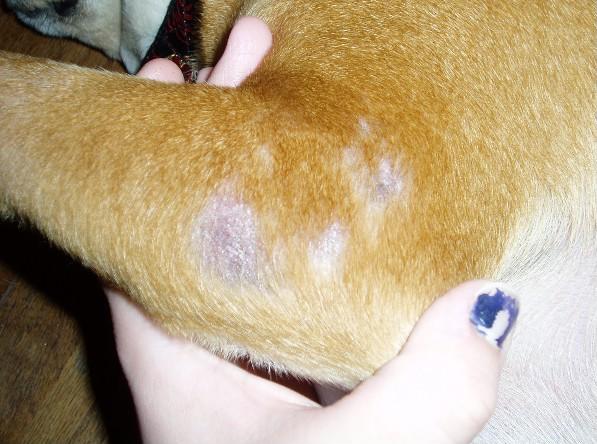
Ringworm in dogs is a very common disease, but ringworm is not a worm but a fungus - little spores land on susceptible skin and start feeding on the dead skin cells. Its appearance as a red ring of rash led to the misnomer ringworm!

SYMPTOMS

Some of the visible signs to detect whether your dog maybe suffering from ringworm disease:

- Small hairless patches on the body
- Scaly skin with dandruff like flakes and with pus in the area
- Red ring of rash
- Common areas of attack are the face, tips of the ears, tail and paws

CAUSES

There are several different types of ringworm or fungi; Microsporum canis is the most predominant one found on dogs and cats. Transmission happens through direct contact with another infected animal or person. People can give it to dogs and vice versa. The fungal spores can live for a very long time in the environment and can usually be found in carpets, bedding etc and infects dog or human when they come in contact with it.

Once your dog is infected with ringworm it can remain contagious for up to 3 weeks and this duration is when the dog is undergoing aggressive treatment. What is heartening to know is that most dogs usually develop immunity to the ringworm disease.

SOLUTION

Ringworm usually last as long as 8 weeks without treatment and then disappears. However to avoid your dog suffering, treatment must be given to cut down the time it will be contagious (please consult your vet if you suspect your dog has ringworm.)

Vets usually prescribe the anti fungal drug Giseofulvin that acts as a fungal inhibitor. This drug has side effects like diarrhea, vomiting and nausea. This tablet does not get absorbed from the stomach unless there is fat included so try giving it to your dog with some fatty meat for it to be effective.

Vets may also prescribe a topical antifungal medication to be applied on the affected areas for a specific period. Be very careful not to get in your dog's eyes.

Antifungal shampoo baths should be given under the guidance of your Vet. You should also bathe any other dogs and cats you may have one time with the shampoo. Don't forget to lather well and leave on for 5 minutes at least.

Lime sulphur dips twice a week are often recommended. It is better for your Vet to administer the dip as it stains clothes and jewelry and worse - it stinks like rotten eggs!

Using a mixture of bleach and water in the ratio 1:10, wipe down all visible surfaces and vacuum daily. Steam clean your carpets and curtains and wash out your dog's bedding and kennel with the bleach solution and lots of hot water. This should kill most of the spores.

PREVENTION

While there is no definite procedure to guarantee prevention of ringworm, you can adopt preventive measures like limited exposure of your dog to other dogs; maintain good hygiene in your home and with your dog's things; groom your dog thoroughly on a regular basis; and by taking steps to avoid cross contamination and human transmission.

by Brandon Roe

How to Get Rid of Canine Acne


As humans we experience skin problems like acne at least once in our lives, but what most don't realize is that we aren't the only ones who need attention when it comes to annoying acne. Believe it or not, our dogs also have the tendency to develop what is commonly known as canine acne, a skin problem caused by the blockage of hair follicles due to substances like keratin and sebum that are plugging debris within the pores.

This kind of skin disorder is common among certain breeds, particularly for 5 to 8 month-old English bulldogs, Boxers, Great Danes, Rottweilers and Doberman Pinschers.

So how can you tell if your dog has acne? Dogs that have this kind of skin problem develop multiply blackheads or comedones in areas like the muzzle, lips, and chin. If left untreated, canine acne can develop swellings, scabs, and more blackheads, which normally do not affect the dog unless these develop into a secondary skin infection that could cause irritation, itching, and of course pain. If you think your dog's lips or chin have blackheads and swellings that might develop into a chronic type of skin disease, the best solution is to take him or her to the local vet for treatment.

Unfortunately, most canine acne cases cannot be cured entirely but it can be controlled with proper treatment and medication.
The vet would normally base his or her findings on the dog's blackheads, but for further assurance he or she might perform a skin biopsy on the dog. This is also to ensure that the canine acne isn't caused by more severe problems such as mite infestations (demodecosis), ringworms, puppy strangles, and other allergies that could be causing the blackheads and swelling to develop.

Here are some options for canine acne treatment:

- The vet will usually recommend regular cleaning of the infected areas with anti-acne products such as benzoyl peroxide or mild anti-seborrhea shampoos in order to lessen and rid the dog of the bacteria that causes the plugging of debris within the skin and to remove such debris effectively.

- Antibiotics may be needed and prescribed if the canine acne becomes worse due to secondary skin infections that could cause incessant itching, scratching, and pain on the dog. The antibiotics are usually needed for 3 to 4 weeks, but there is a possibility that a swab test would be required for further observation. Make sure that the medications used are prescribed from a well-rounded veterinarian so as to prevent further pain and damage from happening to your pet.

- Of course, if things have gotten worse and you see your dog scratching endlessly on the infected parts (especially the face), it would be best to use an anti-inflammatory drug, which usually comes in the form of either a steroid cream or injection that will be able to lessen the discomfort your dog feels. Again, consult the veterinarian first before buying these drugs to ensure the safety of your dog's health.

I also recommend you check out products that naturally help to clear up canine acne by working with your dog's immune system. Some of these products will also help to relieve scratching and itching that may develop as a result of the acne.
----------------
Reprinted with permission by Terrie Simpson, www.K9KlearUp.com. Terrie has been involved in the dog world for over 28 years and has achieved numerous awards with her Springer Spaniels in tracking and obedience. Over that time, she has amassed a good amount of knowledge about how to keep a dog healthy. She is now happy to give back by sharing her experience with other dog owners. Get the best of the canine world right to your inbox - Signup today for the K9Kourier weekly newsletter atwww.K9KlearUp.comand receive a FREE 41 minute MP3 download on "Natural Ways To Care For Your Canine".

What Causes Dog Dermatitis & How to Help Your Hurting Hound


There are a lot of diseases that dogs are prone to and one of them is the infamous itching problem known as dog dermatitis. Dermatitis is basically the general term used to describe transient or chronic itching in dogs that causes not only their coats to become flaky, scaly, and painful but can also affect the overall health of the dog entirely. Since dermatitis is a general term, there are different types of the disease which could either be transient (short-term and can be treated) or chronic (long term and can be fatal to the dog) in nature. If you've noticed your own dog scratching and biting off bits of his or her fur incessantly, it could be a case of canine dermatitis, which means you should take him or her to your local veterinarian for medications and treatments to cure the skin disease.

Causes

To better understand the nature of dog dermatitis, it is important that you know what factors can cause this skin disease in many dogs. In truth, the causes can vary from mere sunburns and flea bites to actual skin cancers and diseases for dogs. In most cases, the most common causes of dog dermatitis include allergies, irritating substances, seborrhea, reactions to drugs or toxins, fungi, bacterial, and parasitical infections, bad reactions to certain kinds of food, and the like. Another factor could be the dog's breed as some are more prone to such skin infections.

Types

As mentioned previously, there are different kinds or types of dog dermatitis, each with their own set of characteristics and symptoms that make them identifiable. Here are some of the most common:

- Canine atopy: this is a very common cause of chronic itching in most dogs and is caused by an allergic reaction to substances in the environment, especially in grassy areas. This also affects mostly dogs between one and five years and that have a weak immune system to resist such substances. Atopy can be identified if the dog itches and scratches a lot, especially in the face and feet that causes skin to become red, moist, and irritated.

- Pyotraumatic dermatitis: usually known or referred to as a "hot spot", this kind of dog dermatitis is usually identified with a red, moist, hairless, and painful sore on the dog's body that appears suddenly. This kind of skin infection is usually common among dog breeds like Golden retrievers, German shepherds, and Bernese mountain dogs that have thick coats and long hair. Pyotraumatic dermatitis develops when the dog licks and scratches his or her skin raw because of something that causes such irritation.

- Contact dermatitis: this is a dog skin disorder that usually develops due to direct contact with certain materials such as fertilizers, flea collars, carpet cleaners, or other corrosive substances used in cleaning the home. It also occurs to dogs that are overly sensitive to a particular substance that is normally not an irritant. It can cause itchy red skin in the parts of the dog's body that has been exposed to the irritant.

Solution

As previously mentioned, as soon as you suspect your dog has dermatitis, you should bring your dog to the vet and seek immediate treatment. I also recommend you consider purchasing specialized balms that help relieve dog dermatitis. There are a variety out there but one of the most effective ones I've ever seen contains the Mayan traditional herb Tepezcohuite.

----------------
Reprinted with permission by Terrie Simpson, www.K9KlearUp.com. Terrie has been involved in the dog world for over 28 years and has achieved numerous awards with her Springer Spaniels in tracking and obedience. Over that time, she has amassed a good amount of knowledge about how to keep a dog healthy. She is now happy to give back by sharing her experience with other dog owners. Get the best of the canine world right to your inbox - Signup today for the K9Kourier weekly newsletter atwww.K9KlearUp.comand receive a FREE 41 minute MP3 download on "Natural Ways To Care For Your Canine".

Yellow Puppies Blogger Template | Template Design | Elque 2008