Showing posts with label pets. Show all posts

Is Your Home Safe For Your Dog?


As threatening as a dog can at times prove to your living room, likewise the home can also be a lot more dangerous to a dog. Some pet owners have learned this the hard way, to their great hurt (and yet greater cost) throughout the years.

Death By Chocolate is not a peculiarly amusing concept in the canine world. Neither, for that matter, is death by slug bait, death by the perpetually lethal antifreeze, nor the rarer death by lead paint poisoning.

Whether you intend to take in a new dog into your household or you already have a dog in your home, the following safety measures will help ensure your pet's better health and happiness:

All medicines, supplements, herbal teas and other concoctions are potentially poisonous to canines and should be kept safely stored in closed cupboards or drawers.

Household cleansing agents and car additives, mainly antifreeze, should also be kept perfectly out of their reach.  The containers should be cautiously trashed of when emptied.

Blue boxes and other trash bins must be kept firmly covered every time.

Never place bugs, cockroach or rat traps where a dog can sniff them out.

Always leave a clean bowl of water out for your dog and discourage it from drinking from the toilet.  Also keep the toilet cover down. As an additional precaution, do not use automatic toilet bowl fresheners when you have pets around.

Never leave food around that could be fatal to a dog. This is particularly crucial in the case of chicken (brittle bones can stab a dog's stomach) and chocolate (which can lead to canine loss of sight and death).

For similar reasons, try to keep small, easily swallowed objects such as coins, toys and knick knacks safely out of the pet's reach.

Bundle up those oh-so-chewable electrical cords before treating them with a bitter-tasting spray, which is available via most petstores and vet's centers.

Some indoor plants and garden plants, can also be toxic to a dog.

© Athena Goodlight

Protected by Copyscape Plagiarism Tool

Working Dogs: Giant Schnauzer


image via Wikipedia
The Giant Schnauzer is the largest of the three Schnauzer breeds. Cattlemen in Southern Bavaria produced the Giant Schnauzer by breeding medium-size Schnauzers with smooth-coated sheep and cattle dogs, with later crossbreeds to rough-haired sheepdogs and black Great Danes. A a time it was known as the Munchener and was prized as a superb cattle and driving dog. It closely resembles the Standard Schnauzer but a bigger and more powerful variant.


WEIGHT: 65-85 pounds

HEIGHT: Males 251/2-271/2 inches; females 23 1/2-25 1/2 inches

COLOR: solid black; pepper and salt.


© Tip Writer

Working Dogs: Standard Schnauzer


The Standard Schnauzer is a medium-sized dog, the oldest breed of the three Schnauzer types. Possibly a result of the crossbreeding of the black German Poodle and Gray Wolf Spitz with Wirehaired Pinscher ancestry, the Standard Schnauzer served as a guard and watchdog in Germany since the 16th century. It is also skilful as a rat catcher in the stable area. Its head is long, rectangular, and robust with a blunt whiskered muzzle.  Its body heavyset and squarely built. Its oval eyes dark and shadowed by bristling eyebrows. The V-shaped ears are small and carried upright when cropped, and the coat is hard and wiry.

WEIGHT: 30-40 pounds

HEIGHT: males 18 ½ -19 ½ inches; females 17 ½ – 18 ½ inches

COLOR: pepper and salt or pure black.


image credit


© Tip Writer

Working Dogs: St Bernard


image via Wikipedia

An ancient breed, the St. Bernard believably descends from the heavy fighting dogs brought in to Switzerland by Roman armies in the 1st century A.D.. He earned fame in the Swiss Alps, where, at the Hospice of St. Bernard, dogs were raised and trained to rescue travelers who get lost in the snow. Its a huge, powerful dog having a strong back and well-developed hindquarters and muscular and strong shoulders. The head is distinguished with its broad forehead, wrinkles and furrow, and muzzle with loose-skinned lips. Its rather high-set ears are medium-sized and lie near the cheeks, and his lower eyelids fit rather loose. The long tail hangs with a flimsy upward curve at the tip. He comes in two coat types: shorthaired (smooth, dense, and tough) and longhaired (medium length, plain to slightly wavy).

WEIGHT: 150-180 pounds
HEIGHT: males minimum of 27 1/2 inches; females minimum of 25 1/2 inches
COLOR: white with red, or red with white; brindle patches with white markings. 


By Tip Writer

Working Dogs: Doberman Pinscher


image via Wikipedia

The Doberman Pinscher takes his name from Louis Doberman, a German tax collector who produced the breed about 1890 by crossing shorthaired Shepherd, old English Black-and-Tan Terrier, Rottweiler, and German Pinscher stock. Popular as an outstanding watchdog, guard dog,  police and war dog, its very elegant-looking and clean of line all over. His head is long and wedge-shaped, and his ears are typically cropped and carried upright. His eyes are almond-shaped instead of round, and his lips are tight. The back is short, and the tail docked, while the smooth, hard coat fits close to the skin.

WEIGHT: 55-75 pounds
HEIGHT: males 26-28 inches; females 24-26 inches
COLOR: black, red, blue, and fawn (Isabella) with rust markings.


Bernese Mountain Dog

image via Wikipedia

The ancestors of this breed were brought in to Switzerland more than 2,000 years ago by invading Roman soldiers. The dogs acted as watchdogs on farms in the canton of Berne who worked as drovers, drawing wagons for basket weavers. A good-looking, strong-boned dog, the Bernese has a long, silky jet-black coat having rust markings on the cheeks and spots over each eye, on all four legs, on each side of the chest, and under the tail. A white blaze graces the muzzle and forehead, white chest markings form an inverted cross, and there is white on the tip of the tail and the feet.

WEIGHT. 80-110 pounds
HEIGHT: males 24 1/2-27 1/2 inches; females 22 1/2-25 1/2 inches
COLOR: black with rich rust and clear white markings. 


Working Dogs: Alaskan Malamute

image via Wikipedia

The Malamute, among the oldest of Arctic sled dogs, was named after the native Innuit tribe, called Mahlemuts, who took root in the north-western part of Alaska. Originally developed to hunt wolves and polar bears, and to haul sledges, in recent years he has been utilized for sled-dog racing and in polar expeditions. They are big and sturdy, having a broad and powerful head, upright triangular-shaped ears, slanting eyes, and distinctive face markings comprising of a cap over the head, with the rest of the face a solid color—or a face marked with the look of a mask. Its feet are the "snowshoe" type, tight and deep, with well-cushioned pads. Its thick and coarse coat is rather short.

WEIGHT: 75-85 pounds
HEICHT: 23-25 inches
COLOR: light gray through intermediate shadings to black with white. 


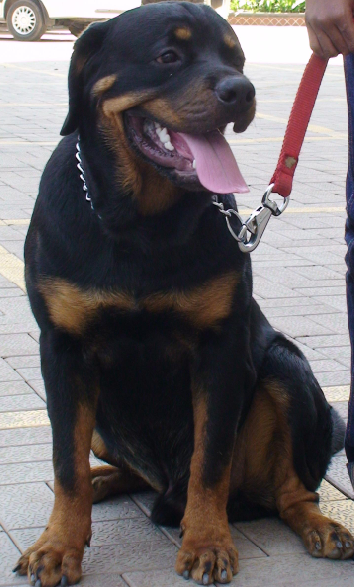
Working Dogs: Rottweiler


image via Wikipedia

When Roman legions got across the Alps almost 2,000 years ago, they employed this breed's Mastiff-type ancestors as guards and cattle drovers. In time these dogs spread out across the Alps into the southern German village of Rottweil, where they were developed with local dogs to create the Rottweiler. For centuries thenceforth, this robust dog drove cattle to market and functioned as a guard and police dog. Its a stockily built, strong animal, calm and quiet. Its back is short, broad and level, his chest spacious, legs straight, with muscular thighs and quite heavy boned. The head is broad between the ears, with muzzle about as long as the depth of the skull. Its almond-shaped eyes bear a good-humored expression, while its small ears hang flat. The coat is short but really dense and hard.

WEIGHT: 85-110 pounds
HEIGHT: males 24-27 inches; females 22-25 inches
COLOR: black with rust to mahogany markings.
By Tip Writer

Working Dogs: Great Pyrenees


image via Wikipedia

The Great Pyrenees or the Pyrenean Mountain Dog is an ancient breed that comes from the earliest-known Asian Mastiffs. It was named after the Pyrenees Mountains, where it worked as a shepherd dog and protected its flocks from wolves and bears. It was a darling of the French royal court in the 17th century. Immense size and a majestic air differentiate the Great Pyrenees. Its head is large and wedge-shaped, measuring about 10 to 12 inches from dome to nose; with sloping dark eyes and V-shaped ears. Its body is strong, his bushy tail long and low when relaxed, but curled high over the back and "making the wheel" while alert. Its coat is his crowning glory—heavy and fine underneath, having a top layer of thick, coarser hair, straight or a bit wavy.

WEIGHT: males 100-125 pounds; females 90-115 pounds
HEIGHT: males 27-32 inches; females 25-29 inches
COLOR: all white, or principally white with markings of badger, gray, or varying shades of tan. 
 By: Tip Writer

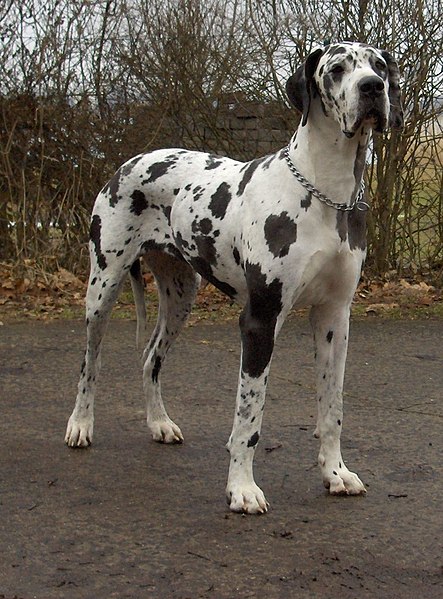
Working Dogs: Great Dane


image via Wikipedia

The Great Dane sprang up in Germany, not in Denmark as one might conjecture, and has been recognized as a distinct type for over 400 years. The growing of the modern type began in Germany in the 19th century, where they were used as a boarhound, and continued in England and the U.S. Its a giant breed, dignified and regal, having a powerful, well-formed body. Its head is long, narrow, and delicately chiselled, his muzzle deep and square with full flews. The eyes are typically dark and quite bright; the ears must be well-pointed and set erect when cropped, otherwise they drop forward near the cheeks. The coat is short, thick, and glossy.

WEIGHT: 120-160 pounds
HEIGHT: males over 30 inches; females over 28 inches
COLOR: brindle, fawn, blue, black, harlequin (pure white with black patches).
By Tip Writer

Working Dogs: Doberman Pinscher


The Doberman Pinscher takes his name from Louis Doberman, a German tax collector who produced the breed about 1890 by crossing shorthaired Shepherd, old English Black-and-Tan Terrier, Rottweiler, and German Pinscher stock. Popular as an outstanding watchdog, guard dog,  police and war dog, its very elegant-looking and clean of line all over. His head is long and wedge-shaped, and his ears are typically cropped and carried upright. His eyes are almond-shaped instead of round, and his lips are tight. The back is short, and the tail docked, while the smooth, hard coat fits close to the skin.

WEIGHT: 55-75 pounds
HEIGHT: males 26-28 inches; females 24-26 inches
COLOR: black, red, blue, and fawn (Isabella) with rust markings. 


By: Tip Writer

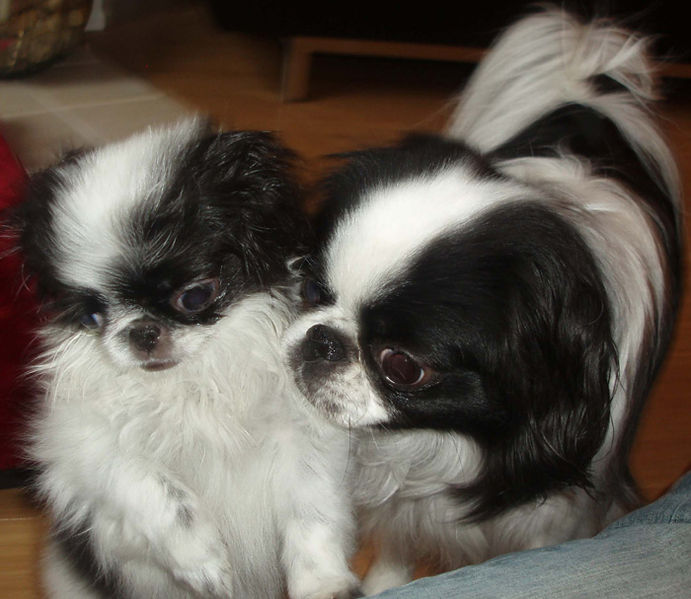
Toy Dogs: Japanese Chin


image via Wikipedia

The Japanese Chin was the spoiled pet of Oriental royalty for centuries and was allowed to associate only with those of noble birth. Commodore Perry first presented them to the West in 1853. A lively, well-bred fellow, the Chin spells quality from nose to tail. Its head is big for his size, having a broad skull rounded in front. His dark lustrous eyes are striking and set wide apart, while his small V-shaped ears fall gradually forward. His muzzle is broad, full, and quite short. The body is square and dense, legs exquisitely boned and tail heavily feathered and set up over the back. The long and silky coat has an inclination to stand out, particularly around the neck, so as to produce a thick mane or ruff.

WEIGHT: 5-7 pounds
HEIGHT: about 10 inches
COLOR: black and white or red and white.

By Tip Writer

Toy Dogs: English Toy Spaniel


image via Wikipedia

English Toy Spaniels, perhaps native to Japan or China, was well known for four centuries in England, where they were pets and darlings of royalty. There are 4 kinds, similar in type but different in color. They're compact and short-bodied dogs, relatively broad in chest. The strange skull is well-domed, with large, dark, widely set eyes. The stop, or indentation between the eyes, is remarkably deep—deep enough to bury a small marble in it—while the short nose is somewhat turned up, as is the under jaw. The coat is long, silky, and wavy.

WEIGHT: 9-12 pounds
HEIGHT: about 10 inches
COLOR: King Charles— black and tan; Prince Charles—white, black, and tan; Blenheim—red and white; Ruby—solid red. 


Brussels Griffon


Brussels Griffon
The Brussels Griffon was produced fairly recently from numerous breeds, among them the German Affenpinscher, the Pug, the Belgian street dog and the Ruby Spaniel. He was an efficient ratter in his native Belgium, but here he is generally a pet and companion. He is short-backed and chunky, with a virtually human expression. The domed forehead bulges over large, wide set eyes, and the ears stand semierect. The nose is exceedingly short and tipped up, the muzzle broad. Bushy eyebrows, whiskers, and cheek fringes complete a curious but appealing picture. There are two distinguishable types of coat: rough and smooth.

WEIGHT: 8-10 pounds
HEIGHT: about 8 inches
COLOR: reddish brown, black, or black with reddish-brown markings.


Teaching Your Dog to Shake Hands


image credit: Petwiki


Even a young pup can learn to "shake hands" since it takes no special strength or skill. It's natural for any dog to lift a paw in greeting or to attract attention. The aim is to make him put out one paw once you tell him to do so.

Now we will stress the importance of the Sit and the Sit-Stay exercises. When your puppy hasn't learned these, teach them first. You'll have to use them constantly. In the Sit, of course, the dog sits alongside you facing straight ahead, while in the Sit-Stay he sits and stays seated as you walk away from him.

Order the leashed pup to Sit-Stay, as you stand facing him. Now stand quite close and a little to one side. Lean toward him. This would make him draw back and raise one foot. If he doesn't raise his foot, tap it softly. Whichever paw he raises as you lean over him, take that paw in your hand and shake it gently as you say "Shake hands!"
 The Dog Tricks and Training Workbook: A Step-by-Step Interactive Curriculum to Engage, Challenge, and Bond with Your Dog
There appears to be right-handed and left-handed dogs, so at the beginning you never know which "hand" you are going to shake. Take the one extended, then later you can teach the pup to shake first with one and then the other. After you shake the first, say "Now the other one!" If he still offers the same paw, just nudge the other one and he would give it to you. Remember the phrase "Good Rover" as you grant him a tidbit. As this trick is mastered—it won't take long—stand far from the dog instead of near him, and lastly, do it without the leash.

101 Dog Tricks: Step by Step Activities to Engage, Challenge, and Bond with Your DogThe Only Dog Tricks Book You'll Ever Need: Impress Friends, Family--and Other Dogs! 

What to Do If Your Dog Has Diarrhea


Diarrhea often ensues from several systemic and other problems. It's occasionally caused by bad feeding. If it occurs only once or twice, it could be nothing more than a slight intestinal upset. A sudden shift in diet can bring it on; a swap from one brand of food to another is best done over a period of a few days, the new food gradually blended in increasing amounts with the old. Often diarrhea results from nervousness or fear brought on by unaccustomed journeys or exhilaration. Spoiled food, likewise, will cause it.

Diarrhea can be an sign of canine distemper or canine parvovirus, in which case the fecal matter emit a particularly foul odor. Intestinal parasites like hookworms and whipworms are also a chief cause. Serious diarrhea involving numerous daily evacuations, evil-smelling or blood-streaked stools, must be treated right away by a veterinarian.

Mild or casual cases may be eased by the same treatment as for vomiting: withholding food and water for 12 to 24 hours, giving only ice cubes to lick, then extending water gradually, after a period of time. At the same time, Kaopectate or Donnagel, given based on your veterinarian's instructions, will help to stop the diarrhea and calm the stomach. Begin giving bland food after twenty-four hours.

Dog Health Issues: Vomiting


Vomiting often happens in dogs of all ages since the dog can vomit at will. When you dose him with a foul-tasting medicine, he might throw it up simply because he doesn't like the flavor. Give him a piece of candy and probably he will throw this up as well. Occasional vomiting, hence, may just show dislike. It's often induced by grass which the dog eats when his stomach feels uncomfortable.
 Dog Owner's Home Veterinary Handbook
Frequent vomiting, nevertheless, can be a symptom of several diseases, among them canine distemper, kidney and liver disease, canine parvovirus, pancreatitis, and bloat (gastric dilation/torsion complex), also digestive upsets. Overloading the stomach is a popular cause; the cure, give less food fed at more frequent intervals. Relentless vomiting of just a little food may entail a change in diet is necessary. Worms can also be responsible; eliminating them solves the problem. Then there are what may be known as mechanical causes, among them poisoning and drug intoxication.
 Dr. Pitcairn's New Complete Guide to Natural Health for Dogs and Cats
To treat everyday vomiting, keep back food and water for 12 to 24 hours to relieve the stomach. After a period, allow the dog lick a few ice cubes when he is thirsty, then water or Gatorade can be given bit by bit in small amounts. During the fast, an antacid product having a protective coating action, like Pepto-Bismol or Maalox, would help sooth stomach upset. Give one to two teaspoons per 20 pounds of body weight every 4 to 6 hours. After 24 hours, give small quantities of bland food: two parts whole-grain rice mixed with one part lean chopped beef or chicken that was boiled to remove the fat; cottage cheese; cooked egg; or baby cereal.

Don't experiment with the persistent vomiter too long, though. Better consult your veterinarian if it does not clear up within 24 hours. And when blood is vomited, particularly a profuse quantity, or if blood clots are present in the vomitus, seek veterinary help straightaway.

Can My Puppy Play Outdoors?


 Can you take a 3-6-month-old puppy outdoors? Naturally! But apply common sense. When it rains or snows, the puppy belongs inside the home. When it is exceedingly cold or very hot, hold him indoors. Draft, wind, and too much direct sun can prove disadvantageous. It is best to avoid them. This is most crucial with small and medium-size breeds. The bigger breeds at this age will be better used to being outdoors.

Keep in mind that most puppy coats are not dense and weather-resistant enough to keep him warm or to cover his body from the sun's rays. He is more sensitive to cold as well because he has more body surface for his weight than a grown dog.
 The Art of Raising a Puppy (Revised Edition)
In fairly warm weather, a certain quantity of exercise on natural grass is good; but it's not safe for any length of time. Particularly when left to himself, the puppy will dig up dirt and stones and could swallow them. He'll enjoy sprawling out on the grass, but if he lies there very long he might get chilled from dampness even though the ground appears warm. If the owner plays with the pup for ten or fifteen minutes, two or three times every day in good weather, that's fine, and that will be adequate. Keep the pup moving and he would benefit from the outing. The safest type of outing for a young pup is in a playpen.
My Smart Puppy: Fun, Effective, and Easy Puppy Training (Book & 60min DVD) 

Tips on Getting a Puppy Playpen


 New Red 45" Pet Puppy Dog Playpen Exercise Pen Kennel 600D Oxford Cloth
To get enough exercise, your puppy must have more space to play. He may be quite mischievous, too, or not completely housebroken, so he can't be given the freedom of the house. Put a tension-bar gate (designed for small children and dogs) in the entrance of the room you want him to stay in. At this age of 3-5 months, weather permitting, dogs of big or heavier-coated breeds can spend some of their time in an outdoor enclosure. They can be fenced in a puppy exercise pen or baby playpen. You can purchase a puppy exercise pen from most pet-supply dealers, or you can build one.
Iris CI-604 Indoor/Outdoor Plastic Pet Pen, 4 Panels 
 Four wired frames can be screwed jointly and bolted to a wooden platform using casters or wheels. If the height of the pen is one inch or two less than the width of the house doors, it can be transported from one room to another, or outdoors. While covering the frames, nail the wire on the outside. It's safer for the puppy because he won't scratch himself.
 Midwest Black E-Coat Exercise Pen, 24 Inches by 30 Inches
Since you may wish to enclose the puppy in the pen for a couple of hours, it is wise to add up a bed in which he could curl up for a nap. For most puppies, a wooden box would do nicely. Cut an opening in the side to serve as an entry. Hinge the top for a cover that can be put up for cleaning or left open if the weather is really warm. Put a blanket or other bedding inside and you have made a snug little harbor free from draft and chill. Sometimes a pup will refuse bedding of any kind and claw it out of his basket, box, or kennel. Don't concern yourself about it. If he favors a bare bed, there is nothing you could do about it.
 Marshall FC-261 Small-Animal Play Pen Mat/Cover, Colors may Vary
Put the pen in the sun when it's cool, and in the shade when it's hot. Face one long side and one short side using canvas as a windshield. The outdoor yard for bigger breeds must have some shade as well as sun, and a place secure from drafts or wind, like a doghouse. If you leave the house, even for a short time, take your dog inside. Don't leave him alone in an outdoor enclosure when nobody is at home, even if your yard is fenced.
40" Heavy Duty Pet Playpen Dog Exercise Pen Cat Fence B 

Dealing With Hyperactive Puppies


Expect every healthy puppy to be mischievous. You could as well make up your mind to it and not worry. Worry more if your puppy is so good he never shreds anything; brace yourself, for he is below par!
 My Smart Puppy: Fun, Effective, and Easy Puppy Training (Book & 60min DVD)
When we say that puppy mischievousness isn't a fault but a virtue, we can hear protests popping up on all sides. But a dog's teeth are considered his fingers, and he must use them if he has the normal energy and curiosity of a healthy young animal. Books and magazines within reach would be gnawed; that hanging corner of the tablecloth will be jerked unmercifully. The world is his, and everything he can grab is a toy to play with.
 Nylabone Puppy Teething Pacifier Chew Toy, Extra-Small
There is just one way to avoid a lot of trouble.  Keep things out of his reach. You can't teach him yet to leave certain objects alone. So make sure to furnish safe and interesting toys to push and pull and tear and wreak his small vengeance on; and then take away all else from his inquiring teeth.
 N-Bone Puppy Teething Ring, 1-Pack
A special warning regarding base plugs: electric outlets having their wires attached are fair game for any puppy. He will try to chew them, and perhaps cause a fire or shock himself. If your puppy does get a shock from chewing through an electric cord and turns unconscious, don't touch him when he is in contact with electrical current. Unplug first the cord from the wall. If you are unable to, wrap a towel around your hand, a broom handle, or use a pencil, or some other nonconductor of electricity to force the wire out of the pup's mouth. Wrap him using a blanket to keep him warm. If the dog isn't breathing, start artificial respiration then get to your vet as soon as possible. Another word of advice: don't drop paper clips, rubber bands, and other small items on the floor, because they could get into a curious puppy's mouth and be swallowed up.

Yellow Puppies Blogger Template | Template Design | Elque 2008