Showing posts with label dogs. Show all posts

Let's Support Local Pet Adoption Centers

Many animals are abandoned by owners. Some of them probably ran away from their previous homes due to abuse or hunger cause by neglect. Some abandoned pets are still waiting for their owners who left them, without knowing that their humans will never arrive at all. It is for this reason, pet shelters and animal rescue centers were established.


The pet shelters are always looking for possible ways to acquire sponsors to fund their operations. Probably you have watched a video or two on YouTube or Facebook on animal rescue stories, some of these videos have moved you to take action. Most of these were produced by animal welfare organizations to raise awareness and support worldwide. These organizations provide the animals that are on their care the proper vaccination and treatment, and the right medication in order for these pets to heal and remain healthy while at their care.

If you feel like getting a pet, do consider going to the shelter first. Although some shelters require some fees when you adopt an animal, it is still so much less than buying a pet from a store. This way, you can give a pet a new lease in life by adopting him or her into your new home.


image courtesy of dan / FreeDigitalPhotos.net

Is Your Home Safe For Your Dog?


As threatening as a dog can at times prove to your living room, likewise the home can also be a lot more dangerous to a dog. Some pet owners have learned this the hard way, to their great hurt (and yet greater cost) throughout the years.

Death By Chocolate is not a peculiarly amusing concept in the canine world. Neither, for that matter, is death by slug bait, death by the perpetually lethal antifreeze, nor the rarer death by lead paint poisoning.

Whether you intend to take in a new dog into your household or you already have a dog in your home, the following safety measures will help ensure your pet's better health and happiness:

All medicines, supplements, herbal teas and other concoctions are potentially poisonous to canines and should be kept safely stored in closed cupboards or drawers.

Household cleansing agents and car additives, mainly antifreeze, should also be kept perfectly out of their reach.  The containers should be cautiously trashed of when emptied.

Blue boxes and other trash bins must be kept firmly covered every time.

Never place bugs, cockroach or rat traps where a dog can sniff them out.

Always leave a clean bowl of water out for your dog and discourage it from drinking from the toilet.  Also keep the toilet cover down. As an additional precaution, do not use automatic toilet bowl fresheners when you have pets around.

Never leave food around that could be fatal to a dog. This is particularly crucial in the case of chicken (brittle bones can stab a dog's stomach) and chocolate (which can lead to canine loss of sight and death).

For similar reasons, try to keep small, easily swallowed objects such as coins, toys and knick knacks safely out of the pet's reach.

Bundle up those oh-so-chewable electrical cords before treating them with a bitter-tasting spray, which is available via most petstores and vet's centers.

Some indoor plants and garden plants, can also be toxic to a dog.

© Athena Goodlight

Protected by Copyscape Plagiarism Tool

Working Dogs: Standard Schnauzer


The Standard Schnauzer is a medium-sized dog, the oldest breed of the three Schnauzer types. Possibly a result of the crossbreeding of the black German Poodle and Gray Wolf Spitz with Wirehaired Pinscher ancestry, the Standard Schnauzer served as a guard and watchdog in Germany since the 16th century. It is also skilful as a rat catcher in the stable area. Its head is long, rectangular, and robust with a blunt whiskered muzzle.  Its body heavyset and squarely built. Its oval eyes dark and shadowed by bristling eyebrows. The V-shaped ears are small and carried upright when cropped, and the coat is hard and wiry.

WEIGHT: 30-40 pounds

HEIGHT: males 18 ½ -19 ½ inches; females 17 ½ – 18 ½ inches

COLOR: pepper and salt or pure black.


image credit


© Tip Writer

Working Dogs: St Bernard


image via Wikipedia

An ancient breed, the St. Bernard believably descends from the heavy fighting dogs brought in to Switzerland by Roman armies in the 1st century A.D.. He earned fame in the Swiss Alps, where, at the Hospice of St. Bernard, dogs were raised and trained to rescue travelers who get lost in the snow. Its a huge, powerful dog having a strong back and well-developed hindquarters and muscular and strong shoulders. The head is distinguished with its broad forehead, wrinkles and furrow, and muzzle with loose-skinned lips. Its rather high-set ears are medium-sized and lie near the cheeks, and his lower eyelids fit rather loose. The long tail hangs with a flimsy upward curve at the tip. He comes in two coat types: shorthaired (smooth, dense, and tough) and longhaired (medium length, plain to slightly wavy).

WEIGHT: 150-180 pounds
HEIGHT: males minimum of 27 1/2 inches; females minimum of 25 1/2 inches
COLOR: white with red, or red with white; brindle patches with white markings. 


By Tip Writer

Working Dogs: Doberman Pinscher


image via Wikipedia

The Doberman Pinscher takes his name from Louis Doberman, a German tax collector who produced the breed about 1890 by crossing shorthaired Shepherd, old English Black-and-Tan Terrier, Rottweiler, and German Pinscher stock. Popular as an outstanding watchdog, guard dog,  police and war dog, its very elegant-looking and clean of line all over. His head is long and wedge-shaped, and his ears are typically cropped and carried upright. His eyes are almond-shaped instead of round, and his lips are tight. The back is short, and the tail docked, while the smooth, hard coat fits close to the skin.

WEIGHT: 55-75 pounds
HEIGHT: males 26-28 inches; females 24-26 inches
COLOR: black, red, blue, and fawn (Isabella) with rust markings.


Working Dogs: Bullmastiff


image via Wikipedia


A mixture of 60% Mastiff and 40% Bulldog, the Bullmastiff was bred in England about 1860 to guard large estates and game preserves free from poachers. Fearless and obedient, they kept company gamekeepers on their late-night rounds. Since they were less visible, the darker brindles were favored to the more common fawn colors. Here is a powerful-looking, short-backed, compact dog having a large, broad head, dark eyes, and a fair quantity of wrinkle on the black-masked face. Ears are V-shaped and carried near the cheeks. The tail, powerful at the root and tapering to the end, might be short or curved. The coat is short and compact, affording good weather protection.

WEIGHT: males 110-130 pounds; females 100-120 pounds
HEIGHT: males 25-27 inches; females 24-26 inches
COLOR: red, fawn, or brindle.

Working Dogs: Great Pyrenees


image via Wikipedia

The Great Pyrenees or the Pyrenean Mountain Dog is an ancient breed that comes from the earliest-known Asian Mastiffs. It was named after the Pyrenees Mountains, where it worked as a shepherd dog and protected its flocks from wolves and bears. It was a darling of the French royal court in the 17th century. Immense size and a majestic air differentiate the Great Pyrenees. Its head is large and wedge-shaped, measuring about 10 to 12 inches from dome to nose; with sloping dark eyes and V-shaped ears. Its body is strong, his bushy tail long and low when relaxed, but curled high over the back and "making the wheel" while alert. Its coat is his crowning glory—heavy and fine underneath, having a top layer of thick, coarser hair, straight or a bit wavy.

WEIGHT: males 100-125 pounds; females 90-115 pounds
HEIGHT: males 27-32 inches; females 25-29 inches
COLOR: all white, or principally white with markings of badger, gray, or varying shades of tan. 
 By: Tip Writer

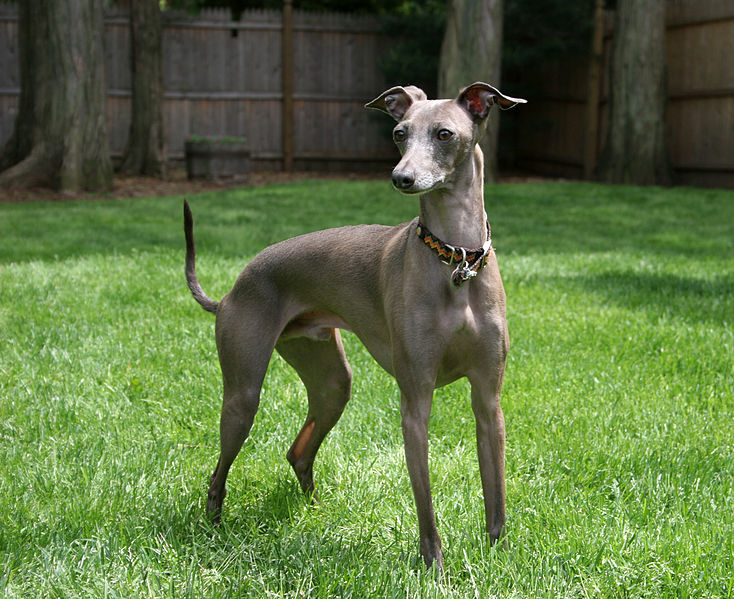
Italian Greyhound


image via Wikipedia

Believed to have originated in the Mediterranean basin around 2,000 years ago, the Italian Greyhound was a darling of European sovereigns, including Francis I of France,  Catherine the Great of Russia, Frederick the Great of Prussia, and Queen Victoria. He is elegant, slender and graceful, a true Greyhound in miniature. The head is long and narrow, the eyes dark and expressive and the muzzle fine. The small ears are tossed back and folded. The body is arching over the loin, the chest is deep, and the tail is long and carried low. The legs are exquisitely boned, having long feet like those of a rabbit. The hair is satiny and soft to the touch, thin and glossy.

WEIGHT: 6-10 pounds
HEIGHT: 13-15 inches
COLOR: any color and markings, sans brindle and tan markings.

Chihuahua


image via Wikipedia

The world's smallest breed of dog begets his name from the Mexican state of Chihuahua. His origins are a mystery, although relics from the ancient Toltec civilization inside northern Mexico show small dogs having large ears that closely resemble modern Chihuahuas. He is all dog, alert and active. He bears a well-rounded "apple-dome" skull, with lean cheeks and jaw, and somewhat pointed nose. His ears are huge, typically erect and flaring slightly outward; his eyes are full and shining. The back is short, the bones relatively fine, the tail moderately long and carried away from the body. There are two coat types, smooth and long.

WEIGHT: under 6 pounds
HEIGHT: about 5 inches
COLOR: any color, solid, marked, or splashed. 

Brussels Griffon


Brussels Griffon
The Brussels Griffon was produced fairly recently from numerous breeds, among them the German Affenpinscher, the Pug, the Belgian street dog and the Ruby Spaniel. He was an efficient ratter in his native Belgium, but here he is generally a pet and companion. He is short-backed and chunky, with a virtually human expression. The domed forehead bulges over large, wide set eyes, and the ears stand semierect. The nose is exceedingly short and tipped up, the muzzle broad. Bushy eyebrows, whiskers, and cheek fringes complete a curious but appealing picture. There are two distinguishable types of coat: rough and smooth.

WEIGHT: 8-10 pounds
HEIGHT: about 8 inches
COLOR: reddish brown, black, or black with reddish-brown markings.


Toy Dog Breed: Shih Tzu


Its origins are a bit obscure, but the Shih Tzu (pronounced sheed-zoo) originated centuries ago, probably in Tibet or China. Its semblance is portrayed in paintings and objects d'art of the Tang dynasty, dating approximately A.D. 624. The breed was known as the "chrysanthemum-faced" dog since its facial hair grew in all directions. Its princely, long and flowing coat, heavily plumed tail, long mandarin beard, and clearly arrogant carriage give the Shih Tzu a beguiling appearance.

WEIGHT: 9-18 pounds
HEIGHT. 8-11 inches
COLOR: varied


Teaching Your Dog to Shake Hands


image credit: Petwiki


Even a young pup can learn to "shake hands" since it takes no special strength or skill. It's natural for any dog to lift a paw in greeting or to attract attention. The aim is to make him put out one paw once you tell him to do so.

Now we will stress the importance of the Sit and the Sit-Stay exercises. When your puppy hasn't learned these, teach them first. You'll have to use them constantly. In the Sit, of course, the dog sits alongside you facing straight ahead, while in the Sit-Stay he sits and stays seated as you walk away from him.

Order the leashed pup to Sit-Stay, as you stand facing him. Now stand quite close and a little to one side. Lean toward him. This would make him draw back and raise one foot. If he doesn't raise his foot, tap it softly. Whichever paw he raises as you lean over him, take that paw in your hand and shake it gently as you say "Shake hands!"
 The Dog Tricks and Training Workbook: A Step-by-Step Interactive Curriculum to Engage, Challenge, and Bond with Your Dog
There appears to be right-handed and left-handed dogs, so at the beginning you never know which "hand" you are going to shake. Take the one extended, then later you can teach the pup to shake first with one and then the other. After you shake the first, say "Now the other one!" If he still offers the same paw, just nudge the other one and he would give it to you. Remember the phrase "Good Rover" as you grant him a tidbit. As this trick is mastered—it won't take long—stand far from the dog instead of near him, and lastly, do it without the leash.

101 Dog Tricks: Step by Step Activities to Engage, Challenge, and Bond with Your DogThe Only Dog Tricks Book You'll Ever Need: Impress Friends, Family--and Other Dogs! 

Competing in Dog Shows


When you take your dog to a show for the first time, this is what you do. Show your ticket at the entrance gate, which admits you and your dog. Nowadays, most shows are "unbenched," which implies that the dogs can come anytime before their scheduled classes and leave right away after, as long as they're no longer needed for additional judging. Some shows are "benched," which means that the dogs have to stay in designated stalls all day long, except when they're being groomed or judged. When the show is benched, the number on your ticket is your dog's bench number.

Be alert in taking your dog into the ring at the right time. You got a timetable in the mail with your ticket, and it gives the beginning for judging of your breed. Be ready in plenty of time, but allow your dog to relax until just before his class, so he would be clean and fresh. You will get a numbered armband at the ring entrance, and next you are in the ring.

A dog show is a series of contests, each more difficult than the last. Judging always starts with the Puppy dog class. When the class has assembled, the judge generally stands in the center and observes the handlers gait their dogs counterclockwise two or three times round the ring. He then motions them to stop. The handlers then pose their dogs at one side of the ring and the judge checks the dogs one by one. Afterward he asks each handler to move his dog in different patterns, so that he can appraise the animal's gait. As the judge examines each dog, he is finding out how closely it compares, in his opinion, with the breed standard. The judge awards first, second, third, and fourth places.

The Novice dog class is judged next in the equivalent manner, and after that the Bred-by-Exhibitor dog, American-Bred dog, and Open dog classes. When the dog classes are ended, the first-place winners get back into the ring and the judge picks the Winner's Dog.

The same class routine is repeated for the bitches, ending with the judge's choice of Winner's Bitch. The dogs that are named Winner's Dog and Winner's Bitch earn points toward their championship. When the regular classes are ended, additional competition carries on between Winner's Dog, Winner's Bitch, and the male and female Champions of Record. From these, the judge picks out Best of Breed, Best of Winners, and Best of Opposite Sex to Best of Breed.

In an all-breed show, there's an additional competition resulting in one dog being distinguished as the best in the show. Each Best of Breed winner competes inside his group: Sporting, Hound, Working, Terrier, Toy, Non-sporting, and Herding. The seven group winners then compete for the grand prize, Best in Show.

Now, this might seem complex. Don't be demoralized. You don't have to understand it all immediately. Actually, if your dog wins first in his class, or even second, third, or fourth, you have every right to rejoice. You can take the ribbon home and show it to your friends with pride . If you win nothing, it's OK; there will be other days, different shows where you and your dog could try once more. But you do not have to keep showing him if you don't want to. Just one show alone would be an interesting experience. Later you can march again if you wish, and learn bit by bit as you go along.

If there's a dog club in your neighborhood, get in touch with the secretary, who would tell you something about the meetings of the group. You'll be welcome to attend, and can learn much about dogs, shows, grooming and general care, and dog breeding as well.

 Dog Show Training - How to Train Your Dog to Beat the Ruff Competition at Dog Shows


What to Do If Your Dog Has Diarrhea


Diarrhea often ensues from several systemic and other problems. It's occasionally caused by bad feeding. If it occurs only once or twice, it could be nothing more than a slight intestinal upset. A sudden shift in diet can bring it on; a swap from one brand of food to another is best done over a period of a few days, the new food gradually blended in increasing amounts with the old. Often diarrhea results from nervousness or fear brought on by unaccustomed journeys or exhilaration. Spoiled food, likewise, will cause it.

Diarrhea can be an sign of canine distemper or canine parvovirus, in which case the fecal matter emit a particularly foul odor. Intestinal parasites like hookworms and whipworms are also a chief cause. Serious diarrhea involving numerous daily evacuations, evil-smelling or blood-streaked stools, must be treated right away by a veterinarian.

Mild or casual cases may be eased by the same treatment as for vomiting: withholding food and water for 12 to 24 hours, giving only ice cubes to lick, then extending water gradually, after a period of time. At the same time, Kaopectate or Donnagel, given based on your veterinarian's instructions, will help to stop the diarrhea and calm the stomach. Begin giving bland food after twenty-four hours.

Dog Health Issues: Vomiting


Vomiting often happens in dogs of all ages since the dog can vomit at will. When you dose him with a foul-tasting medicine, he might throw it up simply because he doesn't like the flavor. Give him a piece of candy and probably he will throw this up as well. Occasional vomiting, hence, may just show dislike. It's often induced by grass which the dog eats when his stomach feels uncomfortable.
 Dog Owner's Home Veterinary Handbook
Frequent vomiting, nevertheless, can be a symptom of several diseases, among them canine distemper, kidney and liver disease, canine parvovirus, pancreatitis, and bloat (gastric dilation/torsion complex), also digestive upsets. Overloading the stomach is a popular cause; the cure, give less food fed at more frequent intervals. Relentless vomiting of just a little food may entail a change in diet is necessary. Worms can also be responsible; eliminating them solves the problem. Then there are what may be known as mechanical causes, among them poisoning and drug intoxication.
 Dr. Pitcairn's New Complete Guide to Natural Health for Dogs and Cats
To treat everyday vomiting, keep back food and water for 12 to 24 hours to relieve the stomach. After a period, allow the dog lick a few ice cubes when he is thirsty, then water or Gatorade can be given bit by bit in small amounts. During the fast, an antacid product having a protective coating action, like Pepto-Bismol or Maalox, would help sooth stomach upset. Give one to two teaspoons per 20 pounds of body weight every 4 to 6 hours. After 24 hours, give small quantities of bland food: two parts whole-grain rice mixed with one part lean chopped beef or chicken that was boiled to remove the fat; cottage cheese; cooked egg; or baby cereal.

Don't experiment with the persistent vomiter too long, though. Better consult your veterinarian if it does not clear up within 24 hours. And when blood is vomited, particularly a profuse quantity, or if blood clots are present in the vomitus, seek veterinary help straightaway.

Dog Rabies Basic Facts


Rabies rarely results in human fatalities, but it persists to be a potentially public health problem worldwide. In the US alone, more than 20,000 Americans have to experience rabies treatments every year as a result of exposure to potentially rabid creatures. Foxes, Raccoons, Skunks and Bats are the major wild hosts in the USA, though domestic cats and dogs are also origins of exposure.

Rabies is caused by a virus. It's spread via the saliva of an infected animal and in no other method. All warm-blooded animals can disperse rabies. Rabid animals can infect other animals by biting them. This entails that your dog won't get rabies unless he is in fact bitten by a rabid animal, or infected by the animal's saliva through an open wound.

Rabies also can be conveyed from animals to man from a bite by a rabid animal. The wound is infected with the virus contained in the saliva of the infected animal. The incubation period ranges from ten days to a few months, depending on the position of the bite and how long the virus takes to reach the brain.

There are two types of rabies: furious and dumb. In the former the first symptom is generally a noticeable change in the dog's behavior, that is, from friendly to snappy and offish. The infected dog might become restless and wind off to hide in dark nooks. His voice could undergo a change in pitch or he might howl. He grows irritable. Typically, he wanders far a field and eagerly assaults anything in his path, including people and other animals. Loud noises or bright lights could induce biting seizures. Finally, the disease develops into the paralytic stage. His throat muscles become too paralyzed that he can't swallow and he drools profusely. It is on this period that he seems to be frothing at the mouth. His legs and body become increasingly paralyzed. There is a lack of coordination, then crash, and ultimately coma and death. Sadly, there is no cure for rabies.

When your dog shows any of these symptoms, or if you know he has been bitten by a strange dog, you should handle him using all possible care. Throw a blanket over him (to keep him from biting you when he's grown snappy), gather him up, and shut him out in a room. Then call your vet immediately. If you are bitten, consult your doctor at once and follow his advice.

Several communities today are encouraging owners to have their dogs immunized by sponsoring rabies-control programs, while some have made vaccination mandatory. This cannot eradicate the disease. Vaccination can reach only a few of the dogs in any community. Responsible owners look after their dogs, but right in the very same town or city live irresponsible owners who allow their dogs run the streets and who'd disown them instead of paying license and vaccination fees.

The free-roaming dog is the major source of infection. To help eliminate rabies, fence your yard and exercise your pet only under control. And encourage your neighbor to control his dog as well. Licensing and vaccination don't grant a dog to run free; any wandering dog can still be a neighborhood nuisance.

Dog Ear Care Tips


The dog's sense of hearing is more effective than ours; in fact he hears twice keener than man. While the dog has ears are very much like our own, its flaps or leather is rather different from the ear shell of man. Made to capture the sound, it also moves to locate the direction from which sound is coming from.

Selective breeding has led in a wide number of ear types. In certain breeds the flap stands upright or pricked; in others it rises halfway and then tips over. In others still, it is "buttoned" or turned down although slightly raised at the base, while in a lot of breeds it falls flat to the head, while it is said to be dropped. The kind of ear flap appears to have no bearing upon the dog's hearing but it does determine the amount of care required. The drop ear or turned-down flap interferes with ventilation, and must be observed more closely.

When a pup is born, the ears are flat to the head. In breeds whose ears stick up at maturity, ear-cartilage strength changes much during the process of growth that the exact age when the ears must come up can't be stated. They may start to stand quite early in life, then, while the teeth are changing, drop once more or flare around unsteadily for weeks or months, after which they ultimately stand  straight and strong.

During play, a pup may wound an ear tendon. The upright ear might then drop and never recuperate. Some folks have helped weak or injured ears to stand by bracing them using surgical adhesive tape or moleskin. Cut the material you're using into the wanted shape and length, then apply it to the inside of the ear to stiffen it. Most puppies will not mind this much, while others would give you a hard time. The first few hours normally are the worst, and if you are able to get through this initial stage, a big part of the battle is won. How long you must leave the ears set depends on the individual dog. Faulty ear carriage is occasionally fixed within a few days; others call for several weeks and several re-settings. Use an antiseptic when you take off the tape.


Some Facts About the Canine Parvovirus


Canine parvovirus is an extremely contagious viral infection that first came out "out of the blue" in 1978. A series of epidemics spanned across the United States, Australia, Canada, and several European countries, causing a rattling mortality rate. It was particularly grave in young puppies, and spread quickly at dog shows and in places where dogs were housed together, like kennels and pet stores. There's proof now that parvovirus didn't exist before the 1978 epidemic.
 Parvaid - All-Natural Parvo Aid for Dogs (1oz)
Parvovirus is spread mainly via contact with the feces of a contaminated animal. A susceptible dog can be infected by ingesting less than a thousandth of a gram of infected fecal material. The virus could also be carried on the hair and feet of infected dogs, and on the clothing and shoes of people who manage them. It can pollute cages and other objects too.

Symptoms come along inside a three to twelve day period and include fever, vomiting, pale gums, and bloody diarrhea. The onset of the disease is sudden and might be preceded by listlessness and loss of appetite. Death may occur in dogs of all ages, though it's more likely in young pups.
 PetAlive Parvo-K, Immunity & Liver Support and Heart & Circulation Tonic UltraPack
Success in treatment depends on early and precise diagnosis made by a vet, as death can happen within 2 to 4 days after the onset of the disease. Treatment comprise of intensive fluid and electrolyte replenishment therapy having antibiotics and vitamins. Numerous days of intensive care is often demanded during the crisis period.

When this lethal virus swept the country, scientists immediately started to formulate vaccines. Nowadays, thanks to the development of an effective vaccine, parvovirus is in check. However, it's vital that puppies be immunized at the proper time. A lot of pups are exposed and most susceptible to the virus at a time while they have too few maternal anti-bodies to protect them but too many to allow for a successful vaccination. Decisions about how soon and how often to vaccinate, thence, should be made on an individual basis by the vet in charge of the dog.

The virus causing this disease is among the most hardy and resistant ever known. It can thrive on many surfaces at room temperature and stay infectious for twelve months or longer. It is also resistant to most antimicrobials. You can help bring down contamination, though, by cleaning kennels or other areas the dog frequents using a solution of chlorine bleach.


Facts About the Dog’s Nose


A dog's sense of smell is so keen that his world is full of scents, others exciting, some soothing, each having a definite message to determine his behavior. When you take your dog out for a walk, watch him closely—to him, half the fun is sniffing areas where other animals, or other dogs, have passed.

Scenting ability differs in certain types of dogs. It appears to be most penetrating in those having long noses, long ears, and pendulous lips, like the hounds and sporting breeds. Shape and color of the nostrils also may be crucial. The keenest noses are usually those whose nostrils are huge, black, and wide open. Exceptions to the color rule are the brown-nosed hunting dogs. An impermanent fading of the nostrils from black to brown is generally caused by some "off" condition; it happens oftentimes to females in season.
Dog Owner's Home Veterinary Handbook
The dog in the house, no matter how long his nose is, can distinguish smells to an amazing level. He feels safe and at home on his blankets since they carry his scent. He loves your old coat or sweater to lie on because it bears your scent. If he rides in the car, his head out the window, he recognizes you've turned homewards because he realizes neighborhood scents. It is nearly unbelievable, but true. A dog can smell formic acid, for example, in a solution carrying only one part of the acid in ten million parts of water; and he can know your scent on an object you have held in your hand for a bare two seconds.

Because the nose is also the organ of breathing, it does its greatest work when the nostrils are clean, cool, and mucus-free. The cold nose, being a sign of a healthy dog has been overrated. A huddle beside a radiator or a snooze under blankets could warm the nose of an animal in the best of health. Dryness, nevertheless, generally indicates fever instead of warmth. When in doubt, always take the dog's temperature.
Infrared Non-Contact Pet Dog Body Thermometer - Instant reading in less than 1 second
 

Mucus or watery discharge is more serious. It indicates bronchial ailment or distemper, but could also result from a simple cold. Clean off the nose using a soft cloth, take away the mucus within the nostrils using a swab, and then lightly grease them with Vaseline of olive oil to maintain them soft. This is significant in the illness since mucus makes breathing hard and forbids the smelling and tasting of food.

© 2011 Tip Writer

Dental Problems of Dogs


image via Wikipedia
Early adulthood is a sound time to have the teeth checked to make sure that the permanent ones are aligned, not crowded too tightly together, free from disease, and not outworn by gnawing. The quantity of actual tooth decay among dogs is negligible. All the same, the dog's teeth can't repair themselves; once the enamel is worn away, they remain damaged and might need treatment or extraction.
 Petrodex Dog Dental Care Kit, Beef Toothpaste with 2 Toothbrushes
Safeguard against tartar, those hard brownish deposit on one or more teeth. The least of its danger is its unsightly color; the real harm is that it threatens the life of the tooth to which it adheres. It's gravest as it pushes into the gum, breaching the membrane which is the tooth's primary brace. Having this support gone, the tooth may loosen and fall out. This condition may not be painful. On the one hand, if food morsels work down into gum cavities and break down to cause abscesses, there would be considerable distress. When tartar is discovered, take the dog to the vet, who can scrape the teeth with expertise before any harm has been done. It's likewise helpful to give some dry meal or biscuits that require chewing.
 IAMS Small Biscuits for Dogs (Original Formula), 24-Ounce Boxes (Pack of 6)
Bones and hard matters are, in a manner of speaking, the dog's toothbrush. Not that they really clean the teeth; they perform an even better service than that. They stimulate the blood supply as they rub all over the gums. Therefore, the gnawing of bones and the chewing of coarse, hard food aids in keeping the entire mouth healthy. That's why as the puppy matures we gradually lay off very moist foods and instead give drier, more crumbly mixtures. And then, while the second teeth are in, we give hard-baked biscuits at times.

All through out the dog's life you might keep his teeth clean by wiping them on a regular basis, using a damp cloth dipped in salt or baking soda, or with a canine toothpaste. A gentle turning motion will stimulate the gums as well as really clean the teeth. The dog used to this attention from puppyhood doesn't object. He relatively enjoys being fussed over.
 Proden Plaqueoff Animal
Don't expect the dog to announce dental troubles by crying. He hurts in silence, while rubbing the affected side of his jaw along the floor or maybe pawing it. He eats gingerly, mouthing his food with his lips instead of his teeth. He may drool as well. All of which may indicate a decomposed, broken, or otherwise tender tooth, or maybe a piece of something wedged between two teeth. In any case, it signifies an uncomfortable mouth demanding professional aid.


Yellow Puppies Blogger Template | Template Design | Elque 2008