The Giant Schnauzer is the largest of the three Schnauzer breeds. Cattlemen in Southern Bavaria produced the Giant Schnauzer by breeding medium-size Schnauzers with smooth-coated sheep and cattle dogs, with later crossbreeds to rough-haired sheepdogs and black Great Danes. A a time it was known as the Munchener and was prized as a superb cattle and driving dog. It closely resembles the Standard Schnauzer but a bigger and more powerful variant.
An ancient breed, the St. Bernard believably descends from
the heavy fighting dogs brought in to Switzerland by Roman armies in the
1st century A.D.. He earned fame in the Swiss Alps, where, at the Hospice of
St. Bernard, dogs were raised and trained to rescue travelers who get lost in
the snow. Its a huge, powerful dog having a strong back and well-developed
hindquarters and muscular and strong shoulders. The head is distinguished with
its broad forehead, wrinkles and furrow, and muzzle with loose-skinned lips.
Its rather high-set ears are medium-sized and lie near the cheeks, and his
lower eyelids fit rather loose. The long tail hangs with a flimsy upward curve
at the tip. He comes in two coat types: shorthaired (smooth, dense, and tough)
and longhaired (medium length, plain to slightly wavy).
WEIGHT: 150-180 pounds
HEIGHT: males minimum of 27 1/2 inches; females minimum of
25 1/2 inches
COLOR: white with red, or red with white; brindle patches
with white markings.
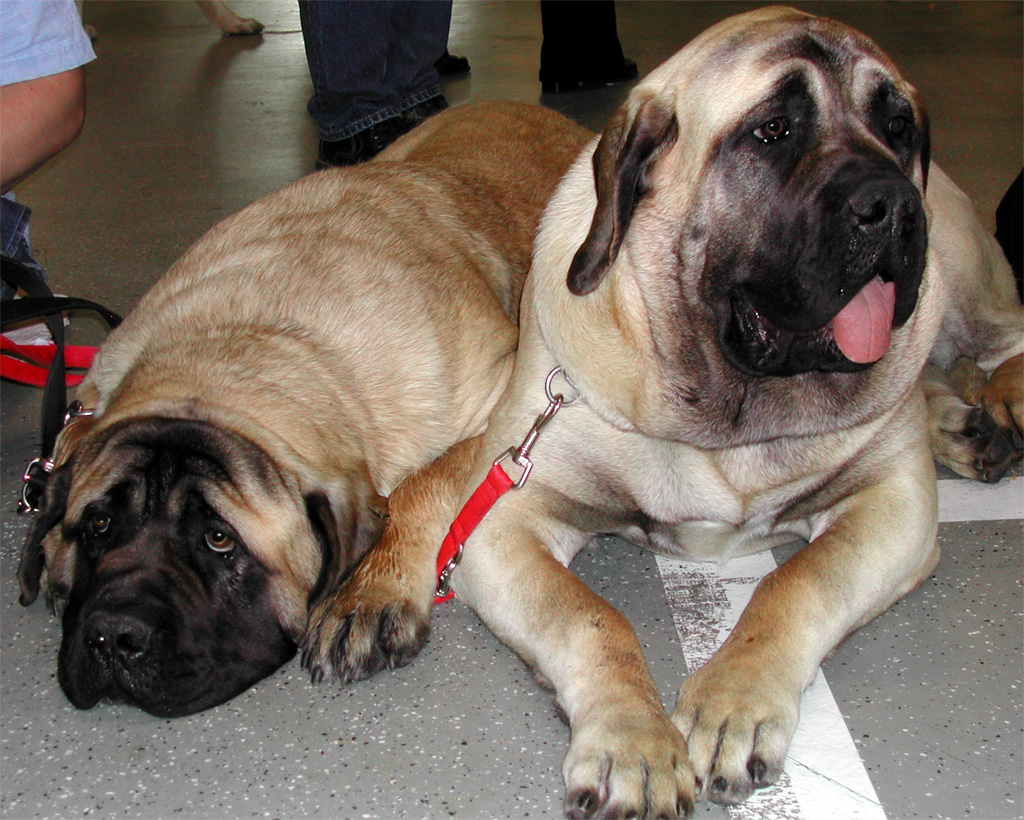
Perhaps Asiatic in origin, the Mastiff comes down from ancient fighting dogs. In 55 B.C. it fought beside its masters in Britain against Caesar's Roman legions, and later at the Circus in Rome, when dogs were pitted against bulls, lions, bears, and tigers. So useful it was as a guard against wild animals that Anglo-Saxon law demanded it on large estates. It is a massive and strongly built dog, slightly arched over the loin, his forelegs straight and hind legs beefy. His head is broad and slightly rounded between the ears, the muzzle stark, forehead a bit wrinkled, dark eyes set apart, and V-shaped ears falling near the cheeks. His long, tapering tail drops straight in repose and produces a slight curve when the Mastiff is in action. The coat is coarse, short, and close-lying.
WEIGHT: 135-185 pounds
HEIGHT males at least 30 inches; females at least 27 1/2 inches,
COLOR: apricot, silver fawn, or dark fawn-brindle, with dark muzzle, ears, and nose
A mixture of 60% Mastiff and 40% Bulldog, the Bullmastiff was bred in England about 1860 to guard large estates and game preserves free from poachers. Fearless and obedient, they kept company gamekeepers on their late-night rounds. Since they were less visible, the darker brindles were favored to the more common fawn colors. Here is a powerful-looking, short-backed, compact dog having a large, broad head, dark eyes, and a fair quantity of wrinkle on the black-masked face. Ears are V-shaped and carried near the cheeks. The tail, powerful at the root and tapering to the end, might be short or curved. The coat is short and compact, affording good weather protection.
The ancestors of this breed were brought in to Switzerland more than 2,000 years ago by invading Roman soldiers. The dogs acted as watchdogs on farms in the canton of Berne who worked as drovers, drawing wagons for basket weavers. A good-looking, strong-boned dog, the Bernese has a long, silky jet-black coat having rust markings on the cheeks and spots over each eye, on all four legs, on each side of the chest, and under the tail. A white blaze graces the muzzle and forehead, white chest markings form an inverted cross, and there is white on the tip of the tail and the feet.
The Malamute, among the oldest of Arctic sled dogs, was named after the native Innuit tribe, called Mahlemuts, who took root in the north-western part of Alaska. Originally developed to hunt wolves and polar bears, and to haul sledges, in recent years he has been utilized for sled-dog racing and in polar expeditions. They are big and sturdy, having a broad and powerful head, upright triangular-shaped ears, slanting eyes, and distinctive face markings comprising of a cap over the head, with the rest of the face a solid color—or a face marked with the look of a mask. Its feet are the "snowshoe" type, tight and deep, with well-cushioned pads. Its thick and coarse coat is rather short.
WEIGHT: 75-85 pounds
HEICHT: 23-25 inches
COLOR: light gray through intermediate shadings to black with white.
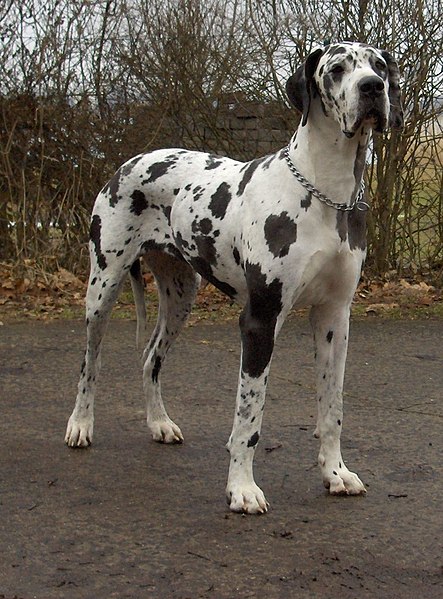
The Great Dane sprang up in Germany, not in Denmark as one might conjecture, and has been recognized as a distinct type for over 400 years. The growing of the modern type began in Germany in the 19th century, where they were used as a boarhound, and continued in England and the U.S. Its a giant breed, dignified and regal, having a powerful, well-formed body. Its head is long, narrow, and delicately chiselled, his muzzle deep and square with full flews. The eyes are typically dark and quite bright; the ears must be well-pointed and set erect when cropped, otherwise they drop forward near the cheeks. The coat is short, thick, and glossy.
WEIGHT: 120-160 pounds
HEIGHT: males over 30 inches; females over 28 inches
COLOR: brindle, fawn, blue, black, harlequin (pure white with black patches).


 Posts
Posts