Showing posts with label dog breeds. Show all posts

6 Things to Seriously Consider Before Getting a Dog or a Puppy

Whether getting a new puppy or a full-grown dog, it is very important to know its background. Unless the dog is rescued out of nowhere and remains unclaimed in a deserted location, you have to know some information about your new canine buddy's past.

This short list will be very useful to those who wish to adopt or buy a dog for the first time or those who wish to get a dog again after a long period of dog-less lifestyle. The dog pound or the dog breeder can surely give you enough information you will need. Often, you will have to ask.
  1. feeding and diet or dietary concerns and preferences
  2. care and treatment of previous owner (Was the dog treated kindly or abused by previous owner?)
  3. breed or traits of parents (certain breeds have unique traits
  4. medical history
  5. vaccinations
  6. current living environment

Knowing these tidbits of information will help you understand the dog's behavior as well as help you anticipate the necessary adjustments as soon as the dog starts living with you. Most dogs will generally respond positively to a loving and caring home.

Even dogs who have been raised in poor breeding and training conditions will still be able to adjust to proper training from a loving and patient human.


image by bravor1x/pixabay.com

Working Dogs: Samoyed


The Samoyed's name originated from the ancient Samoyed people of northeastern Siberia, where it served as hunter, draft dog, and reindeer herder. In more recent times, it served as a sled-dog racer, a pack carrier, and companion in polar expeditions. Basically an Arctic type, agile and strong, having deep chest and well-sprung ribs, powerful neck, straight front, and particularly strong loins, it carries the appearance of being capable of great endurance but without coarseness. Its edge-shaped head carries a broad skull, muzzle tapering off, eyes dark and wide apart, lips black and somewhat curved up at the corners of the mouth like a smile. Its furry ears stand upright. Its heavy coat is beautiful with thick and soft  undercoat, its outer layer longer, harsh, standing off from the body and shining with a silver sheen.

WEIGHT: 40-70 pounds
HEIGHT: males 21-23 inches; females 19-21 inches
COLOR: white, white and biscuit, cream, or all biscuit. 


© TipWriter

Working Dogs: Kuvasz


image via Wikipedia

The Kuvasz is an ancient breed whose ancestors came from Tibet, named after the Turkish Kwaz, meaning “the armed guard of nobility,” It was bred in his present form in Hungary and attained great  prominence throughout the reign of King Matthias I in the 15th century. There it served as a sheep herder and protected noblemen against assaults by the populace. He is characterized by a tough build. His body is deep-chested, broad in back, heavy-boned and muscular, and is embraced with luxurious white hair. His head, regarded to be the most beautiful part of the breed, is complemented by beautiful dark brown, moderately slanted eyes and V-shaped ears.

WEIGHT: males 100-115 pounds; females 70-90 pounds
HEIGHT: males 28-30 inches; females 26-28 inches
COLOR: white.


By Tip Writer

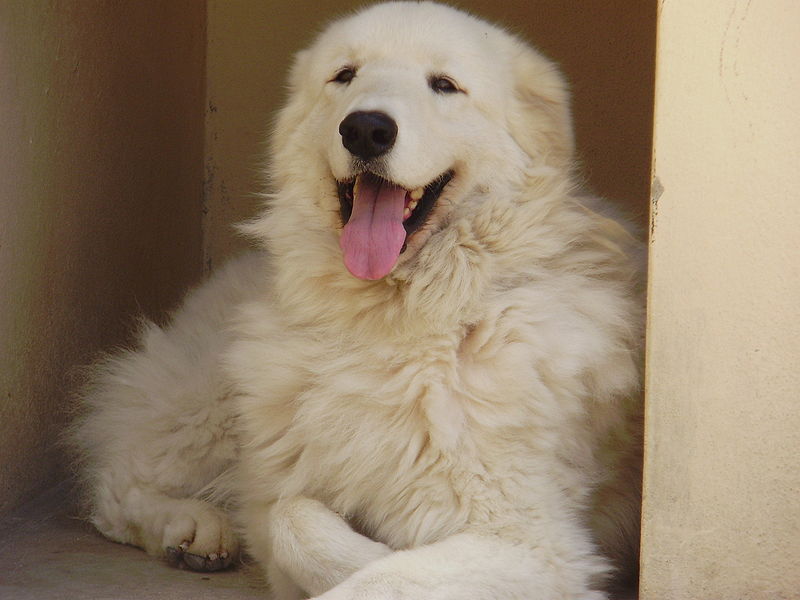
Working Dogs: Great Pyrenees


image via Wikipedia

The Great Pyrenees or the Pyrenean Mountain Dog is an ancient breed that comes from the earliest-known Asian Mastiffs. It was named after the Pyrenees Mountains, where it worked as a shepherd dog and protected its flocks from wolves and bears. It was a darling of the French royal court in the 17th century. Immense size and a majestic air differentiate the Great Pyrenees. Its head is large and wedge-shaped, measuring about 10 to 12 inches from dome to nose; with sloping dark eyes and V-shaped ears. Its body is strong, his bushy tail long and low when relaxed, but curled high over the back and "making the wheel" while alert. Its coat is his crowning glory—heavy and fine underneath, having a top layer of thick, coarser hair, straight or a bit wavy.

WEIGHT: males 100-125 pounds; females 90-115 pounds
HEIGHT: males 27-32 inches; females 25-29 inches
COLOR: all white, or principally white with markings of badger, gray, or varying shades of tan. 
 By: Tip Writer

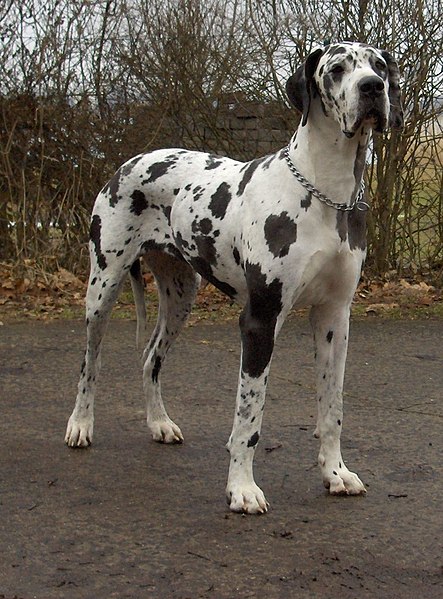
Working Dogs: Great Dane


image via Wikipedia

The Great Dane sprang up in Germany, not in Denmark as one might conjecture, and has been recognized as a distinct type for over 400 years. The growing of the modern type began in Germany in the 19th century, where they were used as a boarhound, and continued in England and the U.S. Its a giant breed, dignified and regal, having a powerful, well-formed body. Its head is long, narrow, and delicately chiselled, his muzzle deep and square with full flews. The eyes are typically dark and quite bright; the ears must be well-pointed and set erect when cropped, otherwise they drop forward near the cheeks. The coat is short, thick, and glossy.

WEIGHT: 120-160 pounds
HEIGHT: males over 30 inches; females over 28 inches
COLOR: brindle, fawn, blue, black, harlequin (pure white with black patches).
By Tip Writer

Toy Dogs: English Toy Spaniel


image via Wikipedia

English Toy Spaniels, perhaps native to Japan or China, was well known for four centuries in England, where they were pets and darlings of royalty. There are 4 kinds, similar in type but different in color. They're compact and short-bodied dogs, relatively broad in chest. The strange skull is well-domed, with large, dark, widely set eyes. The stop, or indentation between the eyes, is remarkably deep—deep enough to bury a small marble in it—while the short nose is somewhat turned up, as is the under jaw. The coat is long, silky, and wavy.

WEIGHT: 9-12 pounds
HEIGHT: about 10 inches
COLOR: King Charles— black and tan; Prince Charles—white, black, and tan; Blenheim—red and white; Ruby—solid red. 


Competing in Dog Shows


When you take your dog to a show for the first time, this is what you do. Show your ticket at the entrance gate, which admits you and your dog. Nowadays, most shows are "unbenched," which implies that the dogs can come anytime before their scheduled classes and leave right away after, as long as they're no longer needed for additional judging. Some shows are "benched," which means that the dogs have to stay in designated stalls all day long, except when they're being groomed or judged. When the show is benched, the number on your ticket is your dog's bench number.

Be alert in taking your dog into the ring at the right time. You got a timetable in the mail with your ticket, and it gives the beginning for judging of your breed. Be ready in plenty of time, but allow your dog to relax until just before his class, so he would be clean and fresh. You will get a numbered armband at the ring entrance, and next you are in the ring.

A dog show is a series of contests, each more difficult than the last. Judging always starts with the Puppy dog class. When the class has assembled, the judge generally stands in the center and observes the handlers gait their dogs counterclockwise two or three times round the ring. He then motions them to stop. The handlers then pose their dogs at one side of the ring and the judge checks the dogs one by one. Afterward he asks each handler to move his dog in different patterns, so that he can appraise the animal's gait. As the judge examines each dog, he is finding out how closely it compares, in his opinion, with the breed standard. The judge awards first, second, third, and fourth places.

The Novice dog class is judged next in the equivalent manner, and after that the Bred-by-Exhibitor dog, American-Bred dog, and Open dog classes. When the dog classes are ended, the first-place winners get back into the ring and the judge picks the Winner's Dog.

The same class routine is repeated for the bitches, ending with the judge's choice of Winner's Bitch. The dogs that are named Winner's Dog and Winner's Bitch earn points toward their championship. When the regular classes are ended, additional competition carries on between Winner's Dog, Winner's Bitch, and the male and female Champions of Record. From these, the judge picks out Best of Breed, Best of Winners, and Best of Opposite Sex to Best of Breed.

In an all-breed show, there's an additional competition resulting in one dog being distinguished as the best in the show. Each Best of Breed winner competes inside his group: Sporting, Hound, Working, Terrier, Toy, Non-sporting, and Herding. The seven group winners then compete for the grand prize, Best in Show.

Now, this might seem complex. Don't be demoralized. You don't have to understand it all immediately. Actually, if your dog wins first in his class, or even second, third, or fourth, you have every right to rejoice. You can take the ribbon home and show it to your friends with pride . If you win nothing, it's OK; there will be other days, different shows where you and your dog could try once more. But you do not have to keep showing him if you don't want to. Just one show alone would be an interesting experience. Later you can march again if you wish, and learn bit by bit as you go along.

If there's a dog club in your neighborhood, get in touch with the secretary, who would tell you something about the meetings of the group. You'll be welcome to attend, and can learn much about dogs, shows, grooming and general care, and dog breeding as well.

 Dog Show Training - How to Train Your Dog to Beat the Ruff Competition at Dog Shows


Popular Breeds of Hypoallergenic Dogs

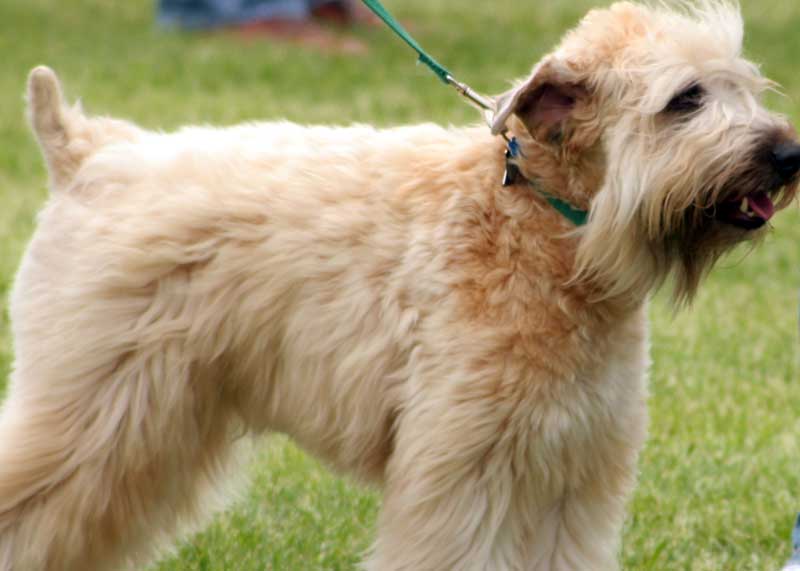
When searching for a hypoallergenic dog, you’ll have to choose on a breed of dog and also how the dog will agree with your lifestyle. A lot of hypoallergenic dogs are medium or small breed dogs. This implies that they’re small sized or medium sized dogs that demand more attending than bigger breeds. Hypoallergenic dogs could lead to you to have fewer allergic reactions since their hair does not shed, they do not have an undercoat, or they don’t shed much dander or dead skin cells The following breeds of hypoallergenic dogs are popular with those who suffer from allergic reaction: Bedlington Terrier, Irish Water Spaniel and Soft Coated Wheaten Terrier.

Read more:  Popular Breeds of Hypoallergenic Dogs

Choosing Hypoallergenic Dogs for Your Family

If you’re searching for a hypoallergenic dog, you’ll have several breeds to select from. From smaller dogs such as the Maltese, to larger breeds like the Greyhound, these dogs tend to shed to a lesser extent, and don’t produce as much saliva or urine. When searching dog breeds, you should remember not only whether they’re hypoallergenic, but also which living conditions they favor, how they conduct themselves around kids, and how much care and maintenance they’ll need. Certain breeds need constant companionship, while other breeds could be left alone all day while you’re at work.

Read more:  Choosing Hypoallergenic Dogs for Your Family

What You Should Know Before Buying a Hypoallergenic Dog

If you wish to have a pet dog but you suffer from allergies, it is not hopeless case. Like most people who are afflicted with some type of allergy, be it food, plant, or animals, you can still find a way to enjoy your life, which in a lot of cases, includes having a pet or two. Depending on how severe your allergy case is, you may be able to take a dog as a pet as long as you make an effort to find the dog breed that is suitable for you.

Read more: What You Should Know Before Buying a Hypoallergenic Dog

How to Choose the Right Pet Dog for Your Lifestyle

Before beginning to choose a pet dog of your own, you must at least have a good idea of what type you are looking for. If you are mainly interested in getting an average dog, you may search one and adopt a dog from your local animal shelter. This will not only help relieve the over population of animals in your locality, but also possibly rescue a loving needy dog. Who knows, you just might meet your next best friend here.

Read more: How to Choose the Right Pet Dog for Your Lifestyle

Yellow Puppies Blogger Template | Template Design | Elque 2008