Showing posts with label puppies. Show all posts

What Should You Look For When Buying a New Puppy?


If you are now ready to take in a new pet dog, here are some pointers to help you choose your new pet puppy.

Visit only reputable dog breeders and ask to see as many puppies as you possibly can. Find a puppy with good temperament aside from its good physical condition because you'll be living with your dog for many years.  It is crucial to know lineage of the puppy you plan to adopt or buy. If it's possible, see and observe the parents of the puppy yourself; observe their friendliness, their energy, and their condition. Inquire if they are easy to train and how they behave around the house.  Genetic traits are important to observe.

Ask to see the whole litter at a time if possible. This may be understandably overwhelming, seeing all frisky little balls of fur.  Check which one is smartest puppy and to which would you like the most. It can be difficult to tell.  Sometimes the friendliest ones may not necessarily be the strongest friend in the long run. One may be an absolute little troublemaker, some others are reserved and coy. Curiosity has long been considered a fairly good measurement of intelligence, yet it isn't a definite guide in gauging the very young pup.
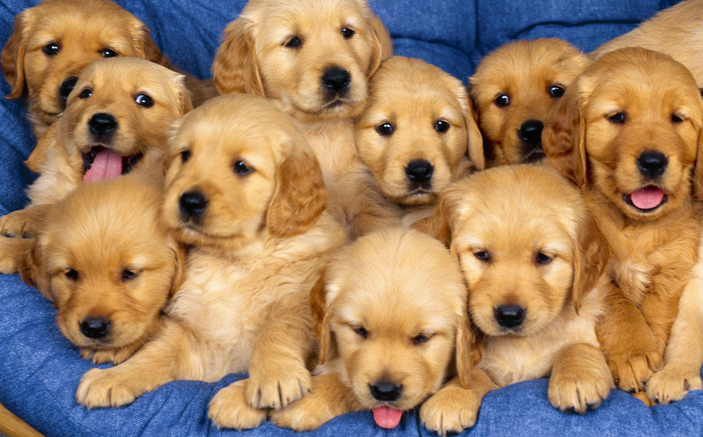
image credit
The chief factor, then, is to find a puppy of excellent lineage and one with visible healthy energy. The healthy puppy is cheerful but not nervous or hyperactive. Check for clean and bright eyes clean, the coat should be shiny, the nose has clean from any mucous discharge, and with healthy-looking skin. The dog's ears should be responsive responds when you talk to him or if you make a sound. The low-spirited, cowering pup should not be immediately disposed as mentally retarded.  It may not be feeling well due to, possibly, a needed worming or medication. If you feel a fondness on a puppy of this type, it is advisable not take him yet. Instead, ask the breeder to get him in tip-top condition, and then visit him later.

It can be very discouraging to be forced to medicate a puppy the moment you take him home. It should not be necessary, and it will not be when you insist on a dog with perfect health upon buying the puppy. Perfect health implies two things: that the puppy is in good health at the present moment, and that he has not been exposed to whatsoever disease or form of infection which could break out in a few days.

Everything else depends on taste entirely. Other people favor a dog with a long tail, others opt for a dog with a short one. Some like upright ears, some like droopy ears. Some want long fur, some short, while larger sizes appeal to many, and the average and toy sizes to other people. Fur color choice also depends on taste, and there is a great deal of shades from which to choose from.

Think of creating a list of your preferences in a dog, then research on diverse dog breeds. See if you could find one which meets your tastes. In the end, the pet that will please you is the one you wish for. This will be your friend and pet whom you'll live with for the next decade or so. Acquire the pet whose appearance delights you; do not allow anybody to decide for you. And remember that size, sex, and fur type will dictate, to an extent, the kind of pet care you should give.


Protected by Copyscape DMCA Copyright Search

Chihuahua


image via Wikipedia

The world's smallest breed of dog begets his name from the Mexican state of Chihuahua. His origins are a mystery, although relics from the ancient Toltec civilization inside northern Mexico show small dogs having large ears that closely resemble modern Chihuahuas. He is all dog, alert and active. He bears a well-rounded "apple-dome" skull, with lean cheeks and jaw, and somewhat pointed nose. His ears are huge, typically erect and flaring slightly outward; his eyes are full and shining. The back is short, the bones relatively fine, the tail moderately long and carried away from the body. There are two coat types, smooth and long.

WEIGHT: under 6 pounds
HEIGHT: about 5 inches
COLOR: any color, solid, marked, or splashed. 

Feeding the Puppies and the Mother Dog


image via Wikipedia
On the first few hours after delivery, find out to see that the mother dog bears a sufficient milk supply for the pups. The nursing period begins with the secretion of a watery-milky fluid known as colostrum. On the first twenty-four hours of life, newborn puppies get antibodies from their mother's colostrum which protect them against particular diseases for the first few weeks of life. If the mother doesn't have enough milk, or if there's too large a litter for her to attend to, then you should give extra bottle feedings.

You could use a commercial dog bitch's milk replacer like Esbilac, or you could make your own formula using two teaspoons Karo syrup, two cups whole milk, and two egg yolks. You may also use two parts of evaporated milk to one of water, putting a small amount of Karo syrup and the yolk of an egg. thoroughly mix  and keep the formula inside the refrigerator, heating whatever amount is utilized at every feeding. A puppy nursing bottle or small doll's nursing bottle may be used for hand-feeding. A baby lamb nipple or the anticolic nipple employed for premature babies is the best type for puppies. Be sure that the hole allows the formula to pass through easily but not too fast. For pups raised entirely by hand, the feedings must be given every four to five hours round the clock.

For hand-fed puppies, it is crucial after each nursing to get a swab of cotton, dip it in warm water, and massage the puppy between its hind legs till it has urinated and had a bowel movement. These substitutes as the mother's washing, which maintains the pup clean and the bowels open.

For the first day or two after the whelping, feed the mother meat, egg, milk, and other soft foods. She will decline bulkier food, which will make her have to leave the puppies more a great deal. Soon dog meal may be added. She needs even more food now than when she was in whelp. Ask your vet about extra vitamins and minerals that might be needed. As time goes on, the matron will require more food throughout lactation; she is feeding her growing litter as well as herself, and she must be well-nourished if she's to make sufficient milk for her brood. Feed her a minimum of three times every day plus a bedtime snack if she desires it.

Can My Puppy Play Outdoors?


 Can you take a 3-6-month-old puppy outdoors? Naturally! But apply common sense. When it rains or snows, the puppy belongs inside the home. When it is exceedingly cold or very hot, hold him indoors. Draft, wind, and too much direct sun can prove disadvantageous. It is best to avoid them. This is most crucial with small and medium-size breeds. The bigger breeds at this age will be better used to being outdoors.

Keep in mind that most puppy coats are not dense and weather-resistant enough to keep him warm or to cover his body from the sun's rays. He is more sensitive to cold as well because he has more body surface for his weight than a grown dog.
 The Art of Raising a Puppy (Revised Edition)
In fairly warm weather, a certain quantity of exercise on natural grass is good; but it's not safe for any length of time. Particularly when left to himself, the puppy will dig up dirt and stones and could swallow them. He'll enjoy sprawling out on the grass, but if he lies there very long he might get chilled from dampness even though the ground appears warm. If the owner plays with the pup for ten or fifteen minutes, two or three times every day in good weather, that's fine, and that will be adequate. Keep the pup moving and he would benefit from the outing. The safest type of outing for a young pup is in a playpen.
My Smart Puppy: Fun, Effective, and Easy Puppy Training (Book & 60min DVD) 

Dealing With Hyperactive Puppies


Expect every healthy puppy to be mischievous. You could as well make up your mind to it and not worry. Worry more if your puppy is so good he never shreds anything; brace yourself, for he is below par!
 My Smart Puppy: Fun, Effective, and Easy Puppy Training (Book & 60min DVD)
When we say that puppy mischievousness isn't a fault but a virtue, we can hear protests popping up on all sides. But a dog's teeth are considered his fingers, and he must use them if he has the normal energy and curiosity of a healthy young animal. Books and magazines within reach would be gnawed; that hanging corner of the tablecloth will be jerked unmercifully. The world is his, and everything he can grab is a toy to play with.
 Nylabone Puppy Teething Pacifier Chew Toy, Extra-Small
There is just one way to avoid a lot of trouble.  Keep things out of his reach. You can't teach him yet to leave certain objects alone. So make sure to furnish safe and interesting toys to push and pull and tear and wreak his small vengeance on; and then take away all else from his inquiring teeth.
 N-Bone Puppy Teething Ring, 1-Pack
A special warning regarding base plugs: electric outlets having their wires attached are fair game for any puppy. He will try to chew them, and perhaps cause a fire or shock himself. If your puppy does get a shock from chewing through an electric cord and turns unconscious, don't touch him when he is in contact with electrical current. Unplug first the cord from the wall. If you are unable to, wrap a towel around your hand, a broom handle, or use a pencil, or some other nonconductor of electricity to force the wire out of the pup's mouth. Wrap him using a blanket to keep him warm. If the dog isn't breathing, start artificial respiration then get to your vet as soon as possible. Another word of advice: don't drop paper clips, rubber bands, and other small items on the floor, because they could get into a curious puppy's mouth and be swallowed up.

Yellow Puppies Blogger Template | Template Design | Elque 2008