Working Dogs: St Bernard


image via Wikipedia

An ancient breed, the St. Bernard believably descends from the heavy fighting dogs brought in to Switzerland by Roman armies in the 1st century A.D.. He earned fame in the Swiss Alps, where, at the Hospice of St. Bernard, dogs were raised and trained to rescue travelers who get lost in the snow. Its a huge, powerful dog having a strong back and well-developed hindquarters and muscular and strong shoulders. The head is distinguished with its broad forehead, wrinkles and furrow, and muzzle with loose-skinned lips. Its rather high-set ears are medium-sized and lie near the cheeks, and his lower eyelids fit rather loose. The long tail hangs with a flimsy upward curve at the tip. He comes in two coat types: shorthaired (smooth, dense, and tough) and longhaired (medium length, plain to slightly wavy).

WEIGHT: 150-180 pounds
HEIGHT: males minimum of 27 1/2 inches; females minimum of 25 1/2 inches
COLOR: white with red, or red with white; brindle patches with white markings. 


By Tip Writer
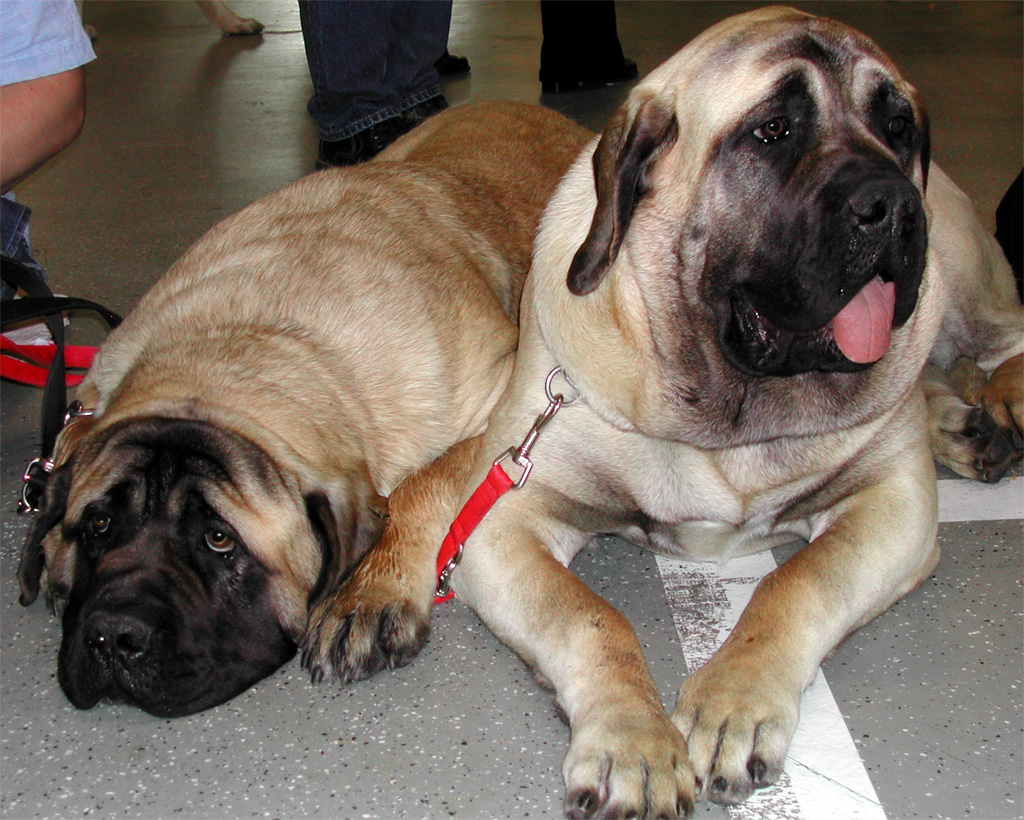
Working Dogs: Mastiff (English Mastiff)

image via Wikipedia
Perhaps Asiatic in origin, the Mastiff comes down from ancient fighting dogs. In 55 B.C. it fought beside its masters in Britain against Caesar's Roman legions, and later at the Circus in Rome, when dogs were pitted against bulls, lions, bears, and tigers. So useful it was as a guard against wild animals that Anglo-Saxon law demanded it on large estates. It is a massive and strongly built dog, slightly arched over the loin, his forelegs straight and hind legs beefy. His head is broad and slightly rounded between the ears, the muzzle stark, forehead a bit wrinkled, dark eyes set apart, and V-shaped ears falling near the cheeks. His long, tapering tail drops straight in repose and produces a slight curve when the Mastiff is in action. The coat is coarse, short, and close-lying.

WEIGHT: 135-185 pounds
HEIGHT males at least 30 inches; females at least 27 1/2 inches,
COLOR: apricot, silver fawn, or dark fawn-brindle, with dark muzzle, ears, and nose


By Tip Writer

Dog's Sweaters and Coats


While your dog goes out walking he might need protection against winter cold. The universal rule is: when you put on a topcoat yourself, set a sweater or coat on your dog if he is used to living in a heated house. Naturally, when he is let out for a couple of minutes to scamper around the yard or when he goes for a walk on a mild day, he does not need to be bundled up. But if he is out for any duration of time, or walked in cold or wind, he must wear a covering.
 Kakadu Pet Explorer Fleece Reflective Dog Coat, 22", Flame (Red)
Should each dog wear a sweater or coat? The bigger, long-haired breeds don't need clothing of any type, particularly when fully grown. By that time their thick undercoat, covered with a coarser outer coat, protects the body from the cold. The flimsy puppy coat, however, isn't weather-resistant. Hence, if your pet is still bearing his puppy coat on his first winter, keep him moving outdoors and dry him well when his hair gets wet. For the fine-haired, thin-skinned, small breeds kept as house pets, these would require sweaters or coats on cold days.
 Suede Shearling Coat - XS Camel
Pet shops typically stock several different types of sweaters and coats for dogs. When selecting one, be sure that it covers the dog's chest, since this is the part that calls for the most protection. Fancy forms that are made of flimsy materials might be pretty to look at but are not much protection against the cold. Raincoats serve another purpose, naturally, and protect the neck and back including the chest. These save the owner loads of work, too, since a dog that's walked uncovered in the rain should be dried well when he comes in.
 Zack & Zoey Camo Companion Jacket Xxl Pink
Have your puppy get used to clothing of some sort while he is still young, for you never know when it might be useful. When sick, a housebroken dog often insists on going outdoors to relieve himself and, at these times, will require extra protection. Be cautious when putting on a sweater for the first few times. Don't scare the dog by pulling it over his head and ears. Rather, hold the sweater in one hand then place your other hand through the neck opening and spread it sufficiently to slip over the head softly.

By Tip Writer

First Aid for Pet Burns and Scalds


Almost all animal burns and scalds ensue from contact with direct heat like hot water, with grease, or other liquids; with chemical agents, or from gnawing on wires. A burn is induced by dry heat, like flames, while a scald is caused by damp heat—hot liquids spilled on the body, for example. Emergency treatment involves the following:

Thermal—For heat burns, help cool the area by putting on cold water or an ice pack for 20-30 minutes. Put on an antibacterial cream. Never apply butter, margarine, grease, salad oil, or other home remedies; these would just trap the heat and hold up the healing.

Chemical—For burns by corrosive chemicals, flush the skin with large amounts of cool water. If the substance contains an alkali, follow with a rinse of equal parts water and vinegar. If the substance contains an acid, follow through using a baking-soda rinse (2 to 3 tablespoons per quart of warm water).

Electrical—unplug the wire from its power source when it is still touching the dog's body. When you can not unplug the cord, cover a heavy towel around your hand or use a ruler, broom handle, or other nonconductor of electricity to force the wire out of the mouth or off from the body. Keep the dog warm and get veterinary attention right away.

Extensive outside burns from fire and scalding liquids can be a very serious emergency. Keep the dog warm and quiet and get prompt veterinary treatment.

© 2011 Tip Writer

Working Dogs: Doberman Pinscher


image via Wikipedia

The Doberman Pinscher takes his name from Louis Doberman, a German tax collector who produced the breed about 1890 by crossing shorthaired Shepherd, old English Black-and-Tan Terrier, Rottweiler, and German Pinscher stock. Popular as an outstanding watchdog, guard dog,  police and war dog, its very elegant-looking and clean of line all over. His head is long and wedge-shaped, and his ears are typically cropped and carried upright. His eyes are almond-shaped instead of round, and his lips are tight. The back is short, and the tail docked, while the smooth, hard coat fits close to the skin.

WEIGHT: 55-75 pounds
HEIGHT: males 26-28 inches; females 24-26 inches
COLOR: black, red, blue, and fawn (Isabella) with rust markings.


Working Dogs: Bullmastiff


image via Wikipedia


A mixture of 60% Mastiff and 40% Bulldog, the Bullmastiff was bred in England about 1860 to guard large estates and game preserves free from poachers. Fearless and obedient, they kept company gamekeepers on their late-night rounds. Since they were less visible, the darker brindles were favored to the more common fawn colors. Here is a powerful-looking, short-backed, compact dog having a large, broad head, dark eyes, and a fair quantity of wrinkle on the black-masked face. Ears are V-shaped and carried near the cheeks. The tail, powerful at the root and tapering to the end, might be short or curved. The coat is short and compact, affording good weather protection.

WEIGHT: males 110-130 pounds; females 100-120 pounds
HEIGHT: males 25-27 inches; females 24-26 inches
COLOR: red, fawn, or brindle.

Bernese Mountain Dog

image via Wikipedia

The ancestors of this breed were brought in to Switzerland more than 2,000 years ago by invading Roman soldiers. The dogs acted as watchdogs on farms in the canton of Berne who worked as drovers, drawing wagons for basket weavers. A good-looking, strong-boned dog, the Bernese has a long, silky jet-black coat having rust markings on the cheeks and spots over each eye, on all four legs, on each side of the chest, and under the tail. A white blaze graces the muzzle and forehead, white chest markings form an inverted cross, and there is white on the tip of the tail and the feet.

WEIGHT. 80-110 pounds
HEIGHT: males 24 1/2-27 1/2 inches; females 22 1/2-25 1/2 inches
COLOR: black with rich rust and clear white markings. 


Yellow Puppies Blogger Template | Template Design | Elque 2008