Teaching Your Dog To Sit on Command


When your dog is already heeling on leash, you must teach him to sit. The two lessons are intimately associated because they're used together when you are walking the puppy on leash.

The pup is trotting on your left side. The leash must be held in your right hand, your left hand just now being set aside for a different action. Coil up the leash into a moderately short length. Halt and command him to "Sit!" Your dog does not understand this command, so you'll have to show what you have in mind. As you give the command, draw the leash upward using your right hand while you press down on his hindquarters using your left to place him in a sitting position. Press lightly, slowly, and don't remove your hand too rapidly. You prefer the dog to sit but not to lie, so you might have to continue the upward draw on the leash. As you give the order, hold your feet still. When you move your feet the puppy would move as well.
 Family Friendly Dog Training: A Six Week Program for You and Your Dog
The first few times, your puppy might be surprised at the pressure and possibly even try to break off. If he refuses, order "Heel!" At once, and begin walking to calm him down. Then try the "Sit!" once more. Keep at it, and he would soon be acting perfectly.

If he lies down rather than sit as he should, odds are that your grasp on the leash was wrong. A slow, solid up-pull on the leash when you issue the order "Sit!" ought to produce the correct pressure. When your grip on the leash isn't that strong, and the dog lies down, never try to compensate by jerking. The error was yours, not the dog's. Reach down, and using your right hand between the forelegs, raise him up to a sitting position, then pet him to express approval.
 How to Raise the Perfect Dog: Through Puppyhood and Beyond
When he arises the moment you take your hand away, that also is your fault. Hold your hand pressed to his hindquarters long enough for him to realize what you want, even if it takes a few seconds. Bit by bit, less pulling and pushing would be necessary and, ultimately, none at all. When your dog sit diagonally rather than squarely, nudge his hindquarters to the right or left so that he faces directly forward.

© 2011 Athena Goodlight 

Heeling: How to Properly Walk Your Dog on Leash


Since leash control is demanded by law in most communities, set out correct leash-walking at a reasonably early age. By this time your puppy must be used to being led using a leash secured to his collar.
The Buddy System - Hands Free Leash - Regular Dog System - Black Regular 
Heeling is a different name for walking properly under leash control; it implies walking with the dog's right shoulder in line with your left knee. If this lesson has been learned, you'll grip the leash in your left hand; your right hand will be free for different duties. Nevertheless, during the training period, the leash is contracted by coiling and is held using your right hand. At the same time, your left hand, palm downwards, holds a part of the leash near the dog's collar to perform firm correction or control. Just how close the collar you place your left hand depends upon the size of the dog.
 Kurgo Quantum Dog Leash, Black
Have the dog on your left side. Go at a fairly brisk pace. Get a quiet path or sidewalk so the pupil's focus won't be disturbed by other animals or humans passing. Your goal is to have your dog walk willingly and readily. He could charge ahead like a little bull, or balk and back away. If he does, tug the leash using your left hand, call his name, and command "Heel!" to get him in line. You'll have to restate the command often the first few times you attempt heeling. Each time the dog moves ahead, lags, or crosses in front of you, tug the leash, call his name, and restate the command "Heel!" After a couple of minor corrections, your dog will line up his steps to your movement.
 Rogz Stylish 5/8-Inch Scooter 6-Foot Dog Lead, Stylish Bones on Red Design
There's a difference between giving commands and causing corrections. Every command of motion must be issued under a calm and pleasant tone, in conjunction with the dog's name. The sharp word and the jerk of the leash are corrections to be utilized when the dog lags behind, for example, or charges ahead, or when he halts to sniff the ground. And if your dog understands and obeys, be giving with your praise. Many lessons daily, around ten minutes each, will be just about right. Puppies tire quickly, so "little and often" is the rule.

© 2011 Athena Goodlight
Protected by Copyscape Website Copyright Protection

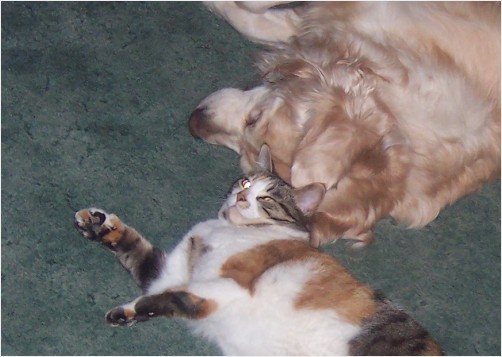
Introducing a Cat to Your Dog

image source
Dogs and cats don't have to be enemies, though they are frequently made so by careless owners who shout "Sic 'im" to the dog each time he sees a cat. Do not ever be guilty of doing this!

When acquainted carefully, and particularly when puppy and kitten grow up together, they turn into firm friends. True, most dogs chase after cats at the slightest chance. The cat takes flight, the dog legs it after him. That is exactly why he does it, because movement charges up the age-old impulse to pursue. The cat in the home, nevertheless, will affect a dog otherwise; it is an animal to be sniffed, investigated, and finally recognized with affection.

When bringing a cat into a home where there's a dog, it's a good thought to keep them in separate rooms for a couple of days. In that way the dog can smell that a cat has joined the home, and the cat senses the presence of a dog. Then when they are joined they are more set up for the introduction.

A kitten and a puppy of reasonably equal age seemingly do not distinguish each other as cat and dog but simply as playmates. When a kitten is gotten into a grown dog's family circle, or a pup is added to an adult cat's home, the resident pet and the newcomer automatically become competitors for attention and affection. When you get a cat if your dog is already grown, select a kitten, cuddle him firmly in your arms, and let the dog notice and smell him. Pay lush attention to the dog, as jealousy can be trouble. If the new arrival acquires all the attention, the dog will feel threatened and might refuse to eat or be destructive. Split up the two after the first meeting. For the next week, permit the pair to get closer with every encounter, till they turn into friends.

© Athena Goodlight
Protected by Copyscape Web Copyright Protection

On Neutering and Spaying Dogs


When your dog is a female, you'll want to choose whether or not she should be spayed. Ovariohysterectomy or spaying, is the removal of the ovaries, uterus, and cervix. It is a procedure often executed to forbid a female from being bred and bearing puppies. Spaying eliminates the female's three-week "season" that attracts male dogs to her. On her season, which occurs around every six months, you'd have to keep her fenced in indoors or board her in a doghouse to keep her from being unexpectedly bred.
 Dog Neutering & Spaying: Must Read for Dog Owners Concerned about the Potential Health Risks and Benefits of Neutering and Spaying (Vet Clinic Pet Guides)
The most beneficial time to spay a female is prior to her first heat period, or when she's between six and eight months old. The procedure can be done at any age, but the earlier it's done, the less complicated the operation is. At this age, healing takes about a week, and in from two to three weeks, the patient is back to usual. At first, however, physical effort, especially running up the stairs and jumping, must be avoided.

When your dog is a male, and you don't want him to sire puppies, he can be castrated or neutered. Neutering, or orchiectomy, is an operation involving the tying of the spermatic cords and the removal of the testicles. The best time to do this operation is if a male is about six and eight months old, before he turns sexually mature and before bad habits are grounded.
 Puppy Whisperer: A Compassionate, Non Violent Guide to Early Training and Care
Spaying and neutering makes dogs more contented and affectionate but less aggressive. Males are less likely to stray and find fights. On average, spayed and neutered dogs live healthier and longer lives. About half of the unspayed females acquire breast and ovarian tumors as they age. Spaying (especially prior to the first heat) tremendously cuts down the risks of breast cancer and uterine and ovarian disease. As un-neutered males age, they often suffer from enlarged prostate glands, testicular tumors, or cancer of the prostate. Neutering brings down these risks.

What are the down sides of spaying and neutering? Neutered animals are ineligible to contend in the show ring. Of course, a female can never give birth, and a male will never sire puppies. For those who like a dog merely as a pet, watchdog, companion, or guard, however, these matters are not disadvantages. On the other hand, if you must plan to get your dog in shows, or to breed your female or use your male at stud at some future time, then definitely she must not be spayed and he must not be neutered.


Puppy Care During Summer or Hot Weather

It's easier to keep a puppy warm than to keep him cool. When a dog gets overheated and perspires, he needs a lot of drinking water to substitute lost fluids. A pan of water laid for him in the morning isn't sufficient. Provide fresh, cool water numerous times daily. Make sure that both the water and the bowl being used for feeding are clean.

Throughout hot weather, exercise your dog in the morning or evening and protect him out of the midday sun. Assure that his outdoor exercise pen has a segment of shade.
Wellness Super5Mix, Just For Puppy Dog Food, 15-Pound Bag 
Do not worry if your dog goes a bit off his food on a hot spell; he may be quite reasonable about eating less at such a time. Give him the same type of food but not quite so much of it. Don't take him for long rides, particularly if you have to leave him alone in the car for any duration of time. A car parked in direct sunlight gets hot inside too quickly; in just minutes, the interior temperature can soar up to 110° F.

Don't clip off his coat because it will help to screen the skin against sunburn and insect bites. Daily brushing would remove many of the dead undercoat which adds to overheating and discomfort. Heavy coats can be reduced but never given a "crewcut." Do not use toxic weed killers or plant sprays where your puppy plays. They can kill your dog or cause him to be quite ill. Fresh paint and varnish should also be kept out of reach.

© 2011 Athena Goodlight
Protected by Copyscape Duplicate Content Penalty Protection

Puppies Sleeping with People

image via Wikipedia

Must the puppy be permitted to sleep in your or your kid's bed? By all means, if you prefer it that way. Provided the pup is sweet and clean and housebroken, no harm would be done to adults or kids, except in the rare instance of human allergy to dog dander. Bringing the puppy with him is among the best means of persuading a child to go restfully to bed. It is also an excellent comforter for lonesome people, young, old, or middle-aged.
Molly Mutt Dog Bed Duvet, Snowcones and Puppies, Small
So far as the puppy himself is concerned, he rests warm and draft-free, with zero danger of chilling when the house heat comes down. If you are afraid of pampering your puppy, remember that some require coddling—if such a term may be used to entail sleeping warmly. A puppy's energy is confined; it can be used for keeping warm or for growing, so allow him to grow.

There are setbacks to having the puppy sleep together with people. Once you start it, you might have to keep it up. The pup would be quite definite to ask you that. Moreover, sleeping covered would "soften" him to a certain point. He should not sleep in a warm bed one night and alone in a cold room the next time.
Small Ultra Soft Brown Sheepskin Cat or Dog Pet Bed, Couch Cuddler 113905BR
The short-coated, thin-skinned small puppy used to sleeping covered must be given a blanket to curl up in for day naps. Create a flannel cover for the blanket or pillow, and leave the ends open so he could crawl in. The aged puppy knows enough to do this. When it's warm, he will sleep outside; when it's chilly, he will crawl in, snug as a bug in a rug. When you have occasion to board out a dog that has forever slept in bed, tell the kennel so they'll offer the additional night warmth needed. If they can't, then board the dog elsewhere.

© 2011 Athena Goodlight
Protected by Copyscape Duplicate Content Detector

Tips on Feeding Your Grown-up Puppy

image source
Most 5-7-month-old puppies won't need the same amount of daily feedings as they did while they were little. Now is the time to cut the bedtime feeding and hand only two meals each day: morning and late afternoon or early evening. The quantity of food he consumes, however, must be increased to cover for the dropped meal and also for his rapid growth places an extra demand on the puppy at this point.

The amount of food needed depends on the individual puppy, the extent of his activity, exercise, size, and weight.
 Natural Balance Dry Dog Food, Ultra Premium Formula, 33 Pound Bag
A significant point is that about three-fourths of your puppy's diet must consist of a balanced, prepared dog food that will afford him all the needed food elements. You will perhaps be able to determine the amount of food necessary to keep your puppy satisfied and in sound weight, neither too fat nor too thin, by watching him. The feeding chart, according to the puppy's weight and caloric need, can help as a guide.

There is a technique called self-feeding where in dry dog meal is kept out for the dog to gnaw at will. Although self-feeding more often suits to the kennel owner, it can also be conformed to house pets, particularly when the owners are away throughout the day.

Bones—should they or should they not be given to your dog? Let us take into account the negatives: bones give little nourishment, may cause constipation, and can irritate or might tear the digestive tract if swallowed. Uninterrupted gnawing of bones wears down the teeth. On the positive side, bones offer chewing exercise and most dogs savor them greatly. At one time bones were believed quite beneficial for dogs, but today they're looked upon as more high-risk than nutritious. Most pet owners give synthetic or rawhide bones instead to gratify their dogs' chewing urge. If you prefer to give real bones to your dog, though, restrict the number to about one a week. Never give him a bone close his regular feeding time. And only give a well-cooked huge bone, like a beef shank or knuckle bone, that won't splinter. Poultry, chop, and other little bones are a bit sharp; they can splinter or be swallowed and do grave harm.
 Pedigree Choice Cuts in Gravy with Beef Food for Dogs, 13.2-Ounce Cans (Pack of 24)
Don't forget that your dog demands water as well as food. In fact, a dog can endure without food a great deal longer than he can without water. Keep fresh water in a bowl where he can drink whenever unless you make it a practice to offer a drink many times a day. The water should be renewed often, especially in hot weather when it can quickly turn warm or fouled by insects.

© 2011 Athena Goodlight
Protected by Copyscape Duplicate Content Detector

Yellow Puppies Blogger Template | Template Design | Elque 2008